
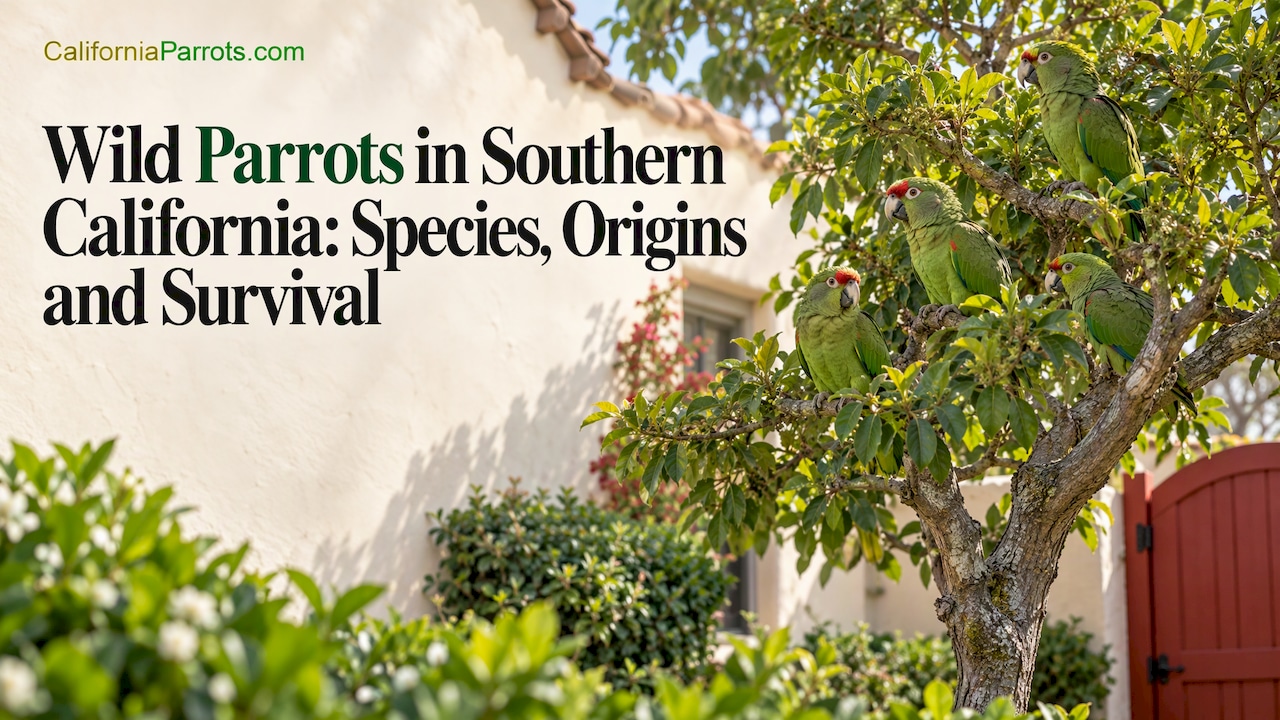
Yes, wild Amazon parrots live in Southern California, and they are not a rumor. Flocks of bright green birds now fly over suburban streets and city parks, descended from escaped or released pets. Two species dominate: the Red-crowned Amazon and the Lilac-crowned Amazon. Both are endangered in their home range in Mexico, which makes these city flocks one of the odder conservation stories in North America.
This guide covers what you need to know: who the parrots are, how they got here, how to tell the two main species apart, what they eat, and what researchers say about their future. We have watched and photographed these flocks for years, and you can see the results in our wild parrot galleries.
Key Takeaways
- Wild Amazon parrots are established in Southern California. The Red-crowned Amazon is the most common, with an estimated 3,000 or more birds, and the Lilac-crowned Amazon numbers around 800.
- All of them descend from pets that escaped or were released. None are native to California.
- Both main species are listed as endangered in their native Mexico, so the California flocks carry real conservation interest.
- You can tell them apart by head color, bill and voice. A pale purple nape means Lilac-crowned. A red forecrown with a bluish nape means Red-crowned.
- The parrots eat mostly ornamental landscaping trees, and the main threats to them come from people, not predators.
Table of Contents
- Are there really wild parrots in Southern California?
- Which Amazon parrot species live in Southern California?
- How did Amazon parrots end up in Southern California?
- How to identify Southern California’s wild Amazon parrots
- When and how to watch wild parrots
- What do wild parrots eat?
- Do wild parrots harm native wildlife?
- Why the Southern California flocks matter for conservation
- Explore the wild parrots with us
- What the future holds
- FAQ
- Sources
Are there really wild parrots in Southern California?
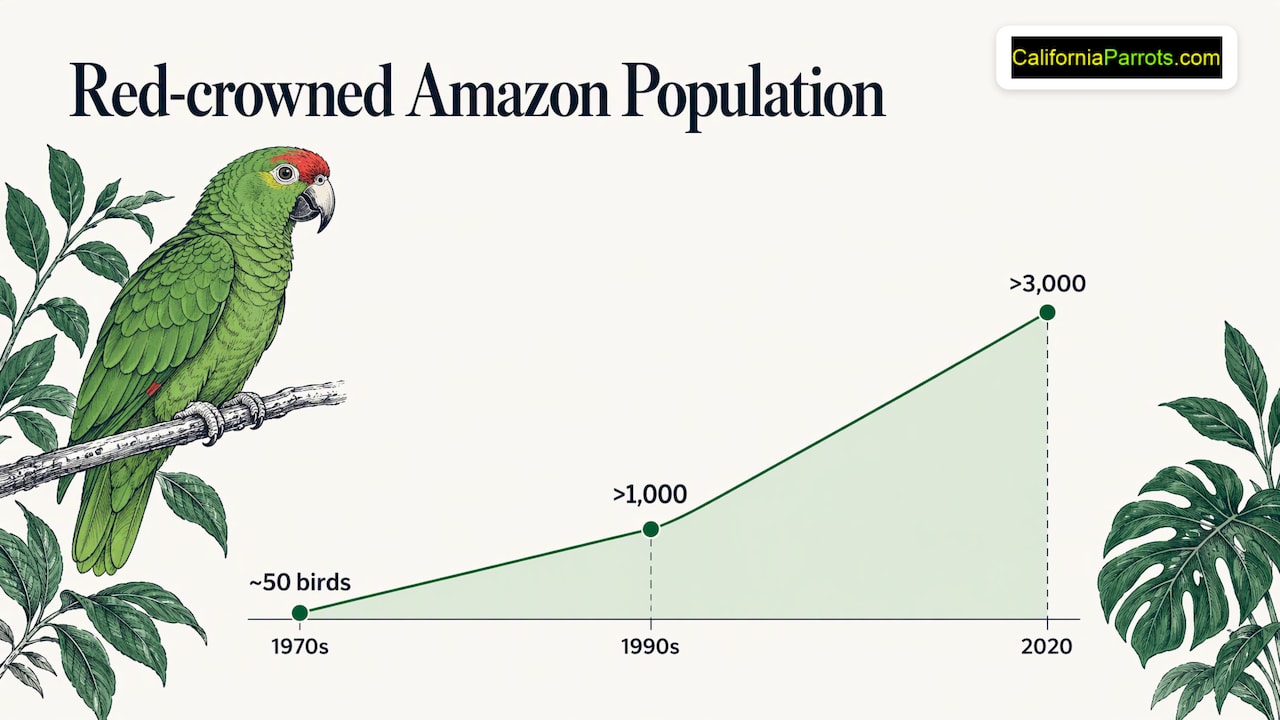
There are, and they have been here for decades. A 2024 study in the journal Diversity and Distributions traces the Red-crowned Amazon’s story: the first pairs were documented in Los Angeles in 1963. The population reached about 50 birds in the 1970s and more than 1,000 by the 1990s. A 2020 estimate puts it above 3,000, and the authors consider that figure likely conservative. The Lilac-crowned Amazon became established later, perhaps in the 1980s, and numbers around 800.
A 1997 survey of greater Los Angeles gives a useful snapshot of the early years. It found ten established parrot species and about 1,080 Red-crowned Amazons. It also found that Red-crowned numbers had climbed since the early 1970s, while Yellow-headed Amazon numbers appeared to have dropped over the same period.
Farther south, the picture is similar. A San Diego Audubon guide reports that San Diego County had an estimated 1,100 established parrots in 2019, about 800 of them Amazons. It counts five established Amazon species in the county.
California’s official bird record keepers have taken note too. The California Bird Records Committee added the birds to its list in 2021, according to the Guardian.
Which Amazon parrot species live in Southern California?
The Amazon genus (Amazona) is a group of medium-sized, mostly green parrots with short, blunt tails. Several have been recorded in the wild in Southern California, but two account for most of what you will see.
| Species | Estimated Southern California population | Conservation status in native range | Key field clue |
|---|---|---|---|
| Red-crowned Amazon | Over 3,000 (2020 estimate) | Endangered | Red forecrown, bluish nape, ivory-yellow bill |
| Lilac-crowned Amazon | Around 800 | Endangered | Less red, pale purple nape |
Population figures come from the 2024 niche study. The Red-crowned Amazon is listed as Endangered by Mexico and the IUCN, the global conservation authority, because of habitat loss and poaching for the pet trade.
Citizen-science records show the same pecking order. Santa Monica Bay Audubon reports that on iNaturalist, the Red-crowned Amazon is the most reported parrot in the region, with 2,864 observations. The Lilac-crowned has 583.
Other Amazon species, including the Yellow-headed, have also been reported in the wild. They are far less common, and the Yellow-headed appears to have declined since the 1970s.
We have a dedicated page on the most abundant species: Red-crowned Parrots.
How did Amazon parrots end up in Southern California?
The short answer is the pet trade. Red-crowned and Lilac-crowned Amazons were brought from Mexico as pets, and some escaped or were let go. The founders came from several routes. San Diego Audubon notes that a local avian veterinarian suggested some local birds may have come from a pet shop. The same guide says some birds may have been released at the border by smugglers fearing prosecution. That is why the guide says the birds cannot simply be called feral.
The full history is messier than any single story, and we cover the events that contributed on our page where California’s wild parrots came from.
Why did they thrive in cities?
The same researchers found something surprising. Both species moved into a shared urban niche that is colder, has less tree cover and gets less rain than their native range. The explanation is landscaping. In the last century, Southern California cities have given these two sister species a food resource that native birds had left untapped: the fruits and flowers of exotic landscaping trees.
Irrigation matters too. The Los Angeles Times reports that the driest month in Southern California is drier than any part of the parrots’ native Mexican range. Watering may close that climate gap by keeping vegetation going all year.
Genetic work points the same way. According to the Guardian, analyses of 40 to 50 birds at Occidental College show the parrots’ biology has shifted as they adapted to temperatures, trees and rainfall far outside their home range.
How to identify Southern California’s wild Amazon parrots
Identification starts with shape and flight, then moves to color and voice.
Shape and flight. Amazons are stocky, with short, blunt tails. Santa Monica Bay Audubon describes their flight as fast, shallow wingbeats, with the wings rising and falling 45 degrees or less from horizontal. That helps you recognize one at a distance, long before you see any color.
Red-crowned Amazon. An Orange County habitat group describes it this way: a red forecrown, bluish nape, ivory-yellow bill and short tail. The red patch reaches further back on males. The flight call is harsh and down-slurred.
Lilac-crowned Amazon. It shows less red than the Red-crowned. Its nape is pale purple, and its calls are squeakier and slur upward. The same guide covers all of these points.
A quick field routine
- Listen first. A harsh, falling call suggests Red-crowned. A squeaky, rising call suggests Lilac-crowned.
- Watch the flight. Quick, shallow wingbeats and a blunt tail confirm an Amazon.
- If the bird perches, check the nape. Bluish means Red-crowned. Pale purple means Lilac-crowned.
- Look at the bill. The Red-crowned’s is ivory-yellow.
- Photograph the head from the side if you can. It makes a later check much easier.
Mixed flocks are common. The Los Angeles Times reports that both species have been seen together in the same flocks, so do not assume every bird in a group is the same species. Our species gallery entry page lets you compare head markings side by side.
When and how to watch wild parrots
Wild parrots are easiest to see and hear at dawn and dusk. LAist’s reporting notes dawn or dusk as the best times for spotting them. In practice that means older residential neighborhoods with mature trees, where flocks move between feeding spots and evening roosts. We do not publish exact locations, and we ask watchers to keep specifics private. These are wild animals that attract the wrong kind of attention, and a precise spot can bring poachers.
Some good habits:
- Watch from a distance with binoculars, and never feed or approach the birds.
- Stay on public sidewalks and parks. Do not enter private property.
- Share sightings in general terms only, such as the city or region, and not the street or tree.
- Keep a notebook of dates, times, flock sizes and behavior. Patterns show up quickly.
What do wild parrots eat?
Southern California’s parrots are generalists that live on the urban forest. San Diego Audubon reports that one local observer identified more than 50 different food sources, most of them ornamental trees.
Earlier research gives concrete examples. A study in Western Birds cites 1981 data from the San Gabriel Valley highlighting English walnut, sweet gum, camphor, blue gum eucalyptus, juniper, western sycamore and pecan as important foods. Walnuts and sweet gum seeds are common street and yard trees, which explains why the parrots suit city life so well.
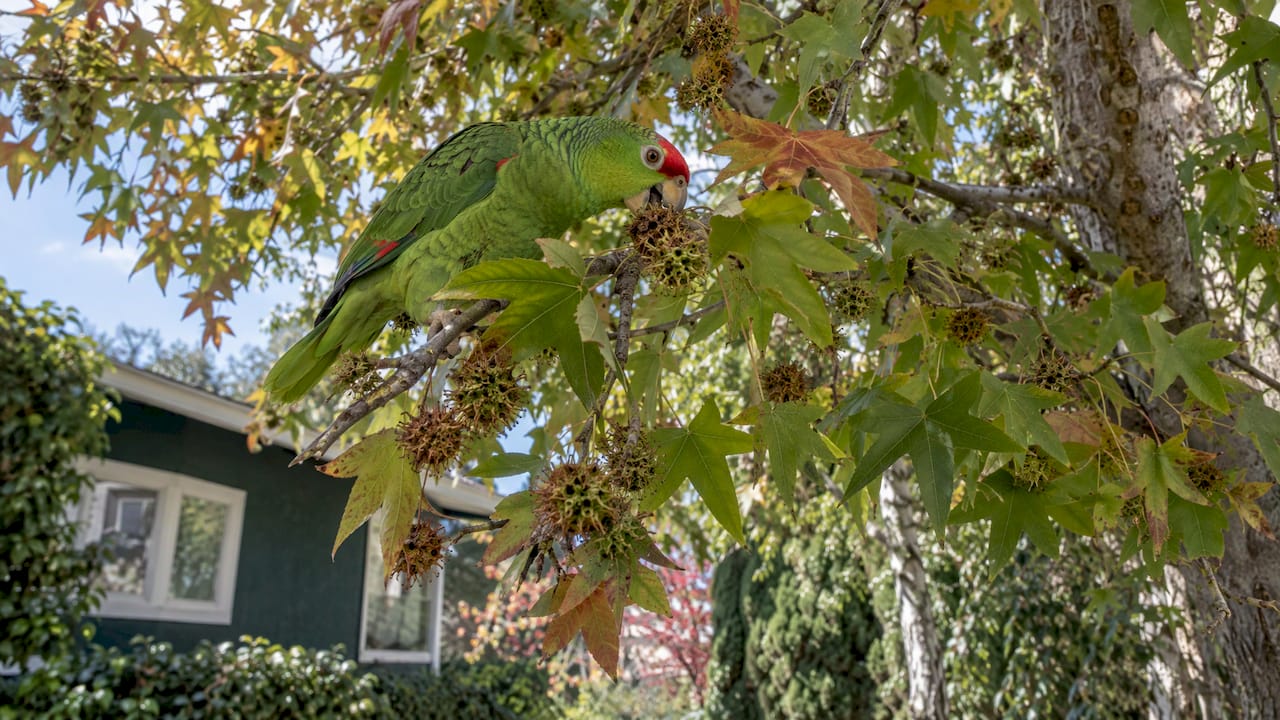
The food supply also shapes the birds’ daily rhythm. They leave their roosts in the morning, move noisily from tree to tree through the day, and gather again toward evening. Because the trees they rely on are planted and watered by people, the flocks stay in and around developed areas.
Do wild parrots harm native wildlife?
The evidence so far says no. The Guardian reports that the parrots have almost no natural predators and do not compete with local wildlife for food, because they eat almost entirely imported ornamental plants. San Diego Audubon’s author describes them as occupying a unique niche. They stay in urban areas, eat ornamental-tree foods some other animals do not use, and may even help spread native plant seeds they eat.
The 1997 survey by Garrett took a measured view. It found that interactions between the parrots and native species were poorly understood but looked limited, and it recommended continued monitoring.
Why the Southern California flocks matter for conservation
Here is the part that surprises most readers. The native Red-crowned Amazon population is small. Smithsonian Magazine reported that some estimates count fewer than 2,000 in their native range, while the Pasadena-area flock is much larger and might be the only thing preventing extinction of the species. The Guardian adds that the native population is believed to be smaller than Los Angeles’.
That has opened a debate. Some scientists see the Los Angeles population as a possible source for repopulating parts of Mexico. The Los Angeles Times notes that mixing between the two species is something to watch, because hybridization could undermine proposals to reintroduce Southern California birds to their native range.
The researchers who wrote the species account for Birds of the World offer a balanced note. The success of naturalized populations has reduced the urgency of some management actions in the native range, but conservation of parrots and their habitat in northeastern Mexico is still paramount.
The biggest threat is people
The parrots have few predators, so human actions matter most. The Guardian reports that the non-native parrots have no legal protection in California beyond basic animal-cruelty rules. It also describes a 2023 incident in which a man netted several birds and killed some of them. The Los Angeles Times documented the same event and noted it was unclear whether the birds were killed or taken for the illegal wildlife market.
That is why we keep locations general. If you see someone trapping or harming wild parrots, report it to local law enforcement.
Explore the wild parrots with us
We have documented these flocks through years of daily observation, and our pages combine firsthand stories with the science above. Start with our main guide to the wild parrots for species profiles and conservation background. Then browse the wild parrot photo gallery, where you can compare plumage, behavior and head markings across species.
If you have a quick question, our FAQ page covers the basics.
What the future holds
These parrots are still changing and still being studied. The Guardian reports that scientists are now tracking how the birds’ biology and range are shifting. The answer to whether they should be used to restore populations in Mexico is still open. What is clear is that a species in trouble at home has found a second foothold in the cities of Southern California, and that watching and recording them responsibly adds to what we know.
FAQ
Are there wild parrots in Los Angeles?
Yes. The Los Angeles area hosts established flocks of Red-crowned and Lilac-crowned Amazons. The first Red-crowned pairs were documented there in 1963, and the species now numbers over 3,000 across Southern California. Early morning and evening are the best times to see or hear them.
Are Southern California’s wild parrots native?
No. They descend from pets that escaped or were released, and none are native to California. Their home range is in Mexico, where both the Red-crowned and Lilac-crowned Amazons are endangered.
Are the wild parrots an invasive problem?
Research so far suggests not. They feed mostly on imported ornamental trees and have almost no predators, and reports indicate they do not compete with local wildlife for food. Scientists still recommend monitoring their interactions over time.
How do I tell a Red-crowned Amazon from a Lilac-crowned Amazon?
Look at the head and listen. The Red-crowned has a red forecrown, a bluish nape and an ivory-yellow bill, with a harsh, down-slurred call. The Lilac-crowned shows less red, has a pale purple nape and makes a squeaky, up-slurred call.
Can I see wild parrots without disturbing them?
Yes. Watch from a distance with binoculars at dawn or dusk, stay on public ground, and never feed them. Share sightings only in general terms so the birds are not put at risk from poachers.
Sources
- Convergent niche shifts of endangered parrots (genus Amazona), Diversity and Distributions, 2024
- Population Status and Distribution of Naturalized Parrots in Southern California, Western Birds, 1997
- Food Items of Naturalized Parrots in Southern California, Western Birds, 1997
- The Naturalized Parrots, San Diego Audubon, 2020
- These parrots came to Los Angeles as pets, then went wild, The Guardian, 2025
- Feral Mexican parrots thrive on exotic L.A. landscaping, Los Angeles Times, 2024
- Identifying Red-crowned and Lilac-crowned Parrots in Southern California, Santa Monica Bay Audubon, 2024
- The Naturalized Parrots of Orange County, OC Habitats, 2024
- Red-crowned Amazon, Birds of the World, 2024
- To Save Endangered Species, Should We Bring Them Into Our Cities?, Smithsonian Magazine, 2018
- Help Study LA’s Parrots, LAist, 2024