
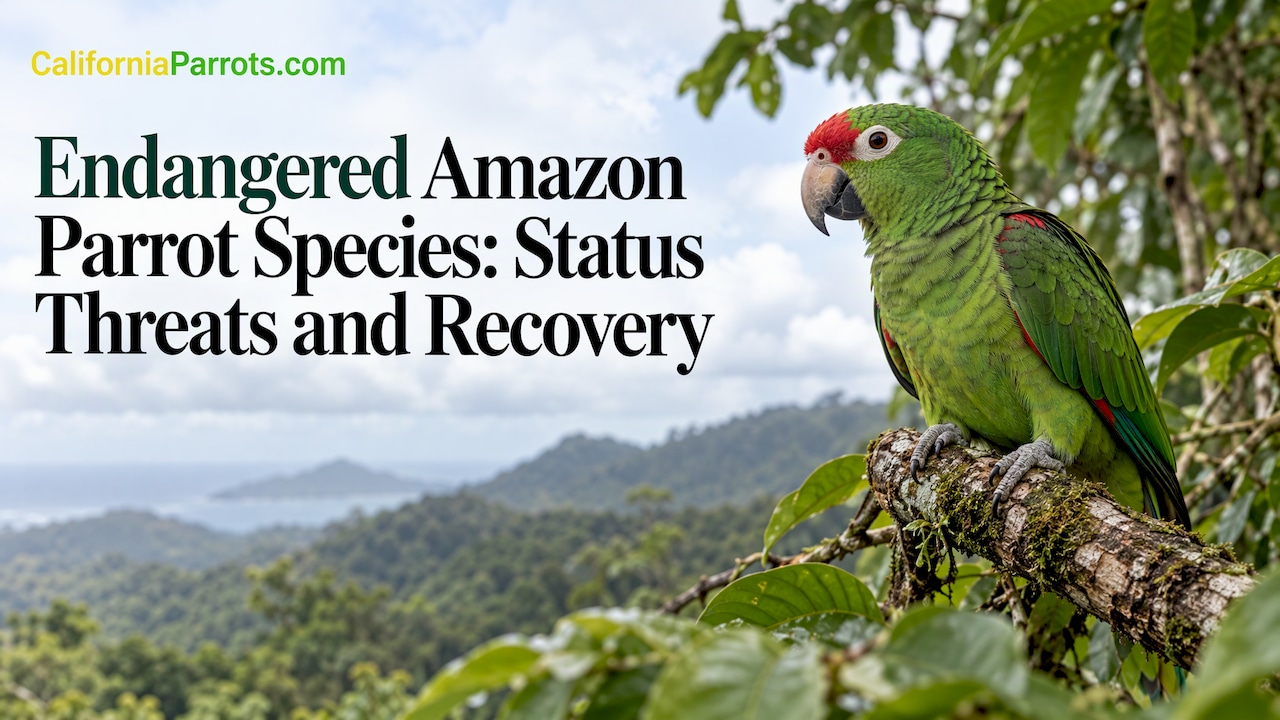
Several Amazon parrot species are threatened in the wild, and the Puerto Rican parrot is the clearest case study of what it takes to bring one back. It has been listed as endangered under the U.S. Endangered Species Act since 1967, and it survives today because agencies have managed it, bird by bird, for decades. This guide explains what “endangered” means, what the numbers say about the Puerto Rican parrot, why Amazons are vulnerable, and why the same species that struggle in their home ranges are also living free in Southern California.
Key Takeaways
- The Puerto Rican parrot (Amazona vittata) is endemic to Puerto Rico and has been listed as endangered under the U.S. Endangered Species Act since 1967, according to the U.S. Fish and Wildlife Service.
- Its numbers have climbed from 13 birds in 1976 to 686 in 2021, but a 2024 peer-reviewed analysis found the wild population still depends on yearly releases.
- Hurricanes are a major threat: Hurricane Maria wiped out the wild group in El Yunque National Forest, and storms are expected to hit harder as the climate changes.
- “Endangered” is a specific status category, not a general word for “rare.” Reading the category and the date of the count tells you far more than a headline does.
- Amazon parrots that struggle in their native ranges also live as free-flying flocks in Southern California, which is why the region matters to conservation awareness.
Table of Contents
- What “Endangered” Actually Means for a Parrot
- The Puerto Rican Parrot: The Best-Documented Endangered Amazon
- Reading the Status of Other Threatened Amazons
- Why Amazon Parrots Are Vulnerable
- Why Southern California’s Wild Amazons Matter
- See and Learn About Amazon Parrots With Us
- How to Follow Conservation News Without Being Misled
- What the Puerto Rican Parrot Teaches About Saving Threatened Parrots
- FAQ
- Sources
What “Endangered” Actually Means for a Parrot
People use “endangered” loosely. In conservation it is a formal label, and two systems matter most to readers in the United States.
The first is the IUCN Red List, the global scientific assessment of how close a species is to extinction. It sorts species into steps: Vulnerable, Endangered, Critically Endangered, Extinct in the Wild and Extinct. Each step is based on population size, how fast numbers are falling and how small the range is.
The second is the U.S. Endangered Species Act, a federal law. A species listed under it receives legal protection and a government recovery program. The two systems do not always agree, because one is a scientific ranking and the other is a legal listing. A parrot can be rated in one way by the IUCN and carry a different label in U.S. law.
When you read about a threatened parrot, check three things:
- Which system is speaking. IUCN status and Endangered Species Act status are different things.
- When the count was made. Wild bird numbers change with every survey, storm and release season.
- Whether the number counts wild birds only. Totals that mix wild and captive animals describe a very different situation from wild-only counts.
That third point is the one that trips up most headlines about “how many are left.”
The Puerto Rican Parrot: The Best-Documented Endangered Amazon
The Puerto Rican parrot is the only parrot native to the U.S. territory of Puerto Rico, and it is an Amazon. The U.S. Fish and Wildlife Service describes it as endemic to Puerto Rico, meaning it lives naturally nowhere else on Earth. It has been endangered under the Endangered Species Act since 1967.
How many are left
There are two figures, and it matters which you use.
- Total, wild and captive together: The Fish and Wildlife Service’s recovery program document, updated in February 2026, reports more than 900 Puerto Rican parrots in all.
- Wild only, one forest: In March 2025, a count in El Yunque National Forest found 75 to 80 wild birds, after 32 aviary-raised parrots were released there in January 2025. Local reporting called it the highest number in that forest since the recovery program began in 1973.
The gap between those two numbers tells the whole story. Hundreds of birds exist, but only a fraction live free, and the free-living groups are small.
From 13 birds to hundreds
A 2024 population viability analysis, a peer-reviewed study that models a species’ chances of surviving over time, traced the population from a low of 13 birds in 1976 to 686 in 2021. That is one of the more striking recoveries among threatened parrots anywhere.
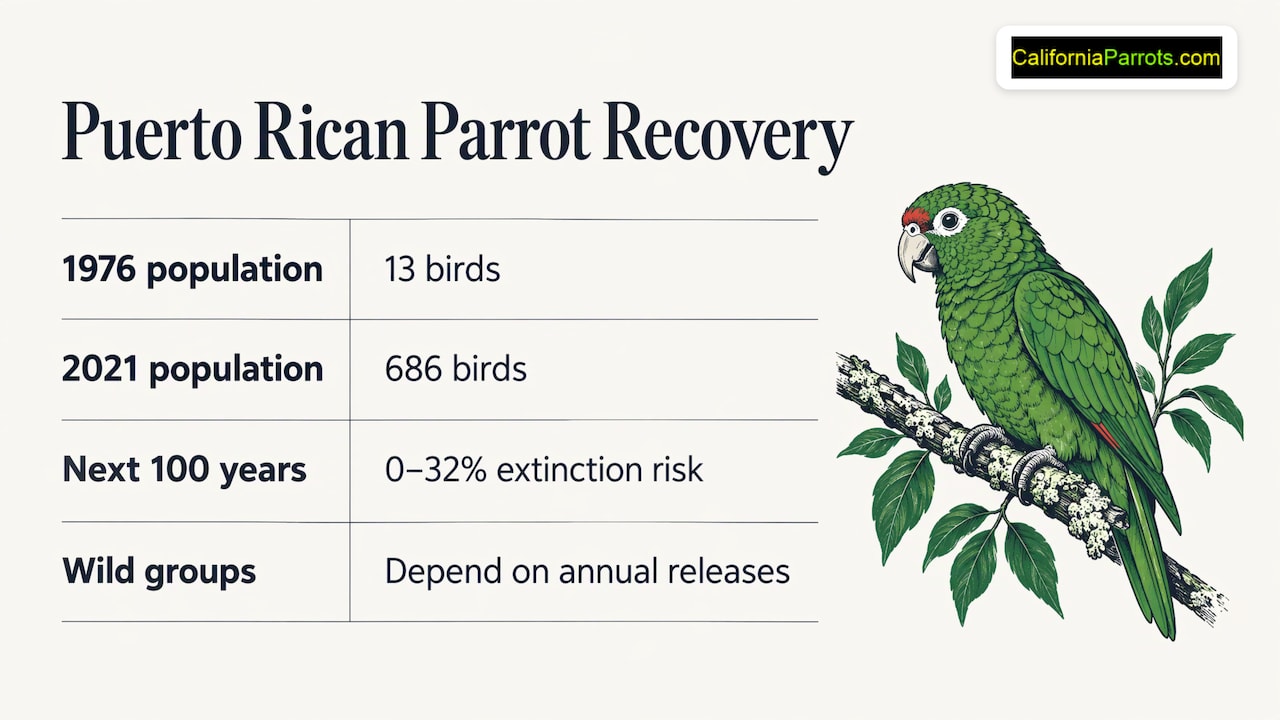
The same study is careful about what comes next. Under current management, it estimated the wild populations face an extinction risk of 0 to 32 percent over the next 100 years. It also found that the wild groups remain dependent on annual releases, and that hurricanes make long-term recovery harder.
That range is wide because the answer depends on decisions people make. The authors of a 2025 study in Animal Conservation concluded that recovery will stay management-dependent unless the underlying survival rates change, for example by cutting first-year deaths through targeted predator control. They also noted that stronger hurricanes driven by climate change make it less likely that wild populations will stabilize on their own.
Who is doing the work
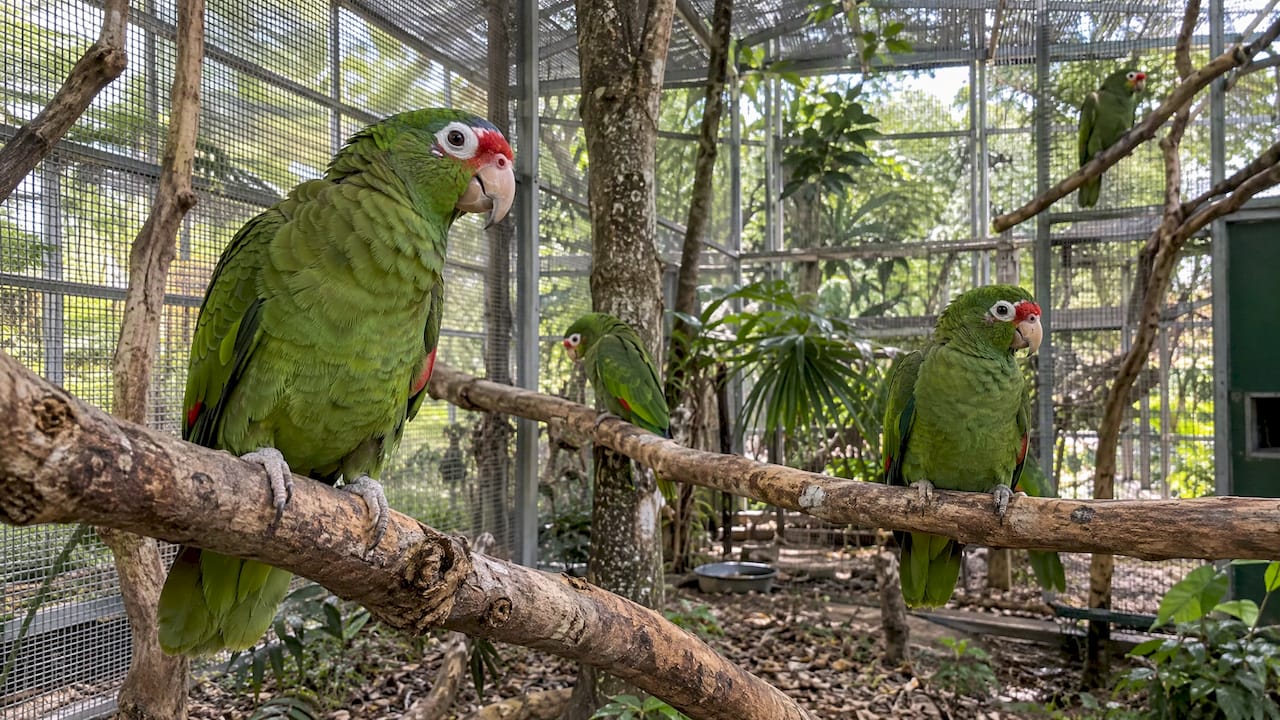
The recovery effort is a partnership. The Fish and Wildlife Service, Puerto Rico’s natural resources department and the U.S. Forest Service manage the species at three locations: El Yunque National Forest, Río Abajo Commonwealth Forest and Maricao Commonwealth Forest. Aviaries support the program, and birds are released into the wild from them. Recovery work resumed after Hurricane Maria, which eliminated the wild group at El Yunque and reduced the Río Abajo population by 40 percent.
Reading the Status of Other Threatened Amazons
The Puerto Rican parrot is not the only Amazon in trouble. The Amazon genus (Amazona) is large, spread across Mexico, Central America, South America and the Caribbean, and many of its members live on islands or in small patches of remaining forest. Island species are especially exposed because one hurricane, one disease outbreak or one stretch of habitat loss can affect most of the population at once.
The table below shows how to read a species’ status once you find it. It is a reading guide, not a ranking of individual species.
| Status label | What it signals | What to look for next |
|---|---|---|
| Vulnerable | Facing a high risk of extinction in the wild | Whether the population trend is falling or stable |
| Endangered | Facing a very high risk of extinction in the wild | Wild-only count and the date of the survey |
| Critically Endangered | Facing an extremely high risk of extinction | Whether recovery depends on releases |
| Extinct in the Wild | Survives only under human care | Plans for reintroduction |
For current labels on any Amazon species, go to the IUCN Red List entry for that species, which is revised as new surveys come in. Our own species guides cover the conservation picture for the Amazons that live in California, starting with the red-crowned Amazon, and you can browse them all on the Wild Parrots pages.
Why Amazon Parrots Are Vulnerable
No single cause explains why a parrot becomes endangered. The Puerto Rican parrot shows how several pressures stack up on one species.
Storms. Hurricane Maria eliminated the El Yunque wild group and cut the Río Abajo population by 40 percent, according to the Fish and Wildlife Service. For a species with only a few hundred birds, a single weather event can erase decades of progress.
A small population in a small place. A species confined to a few forests has nowhere else to go when conditions change. That is why the Puerto Rican parrot program spreads management across three separate locations instead of one.
Climate change. The 2025 modelling study linked climate-driven hurricane impacts to a lower chance that wild populations stabilize without help. Stronger, more frequent storms raise the stakes every season.
Early-life survival. The same researchers identified first-year mortality as a lever. Improving how many young birds survive their first year, for instance through targeted predator control, changes the long-term outlook.
These pressures are why conservation of a threatened Amazon is rarely a one-time rescue. It is a program that has to keep running for decades, with scientists adjusting as conditions change.
Why Southern California’s Wild Amazons Matter
The free-flying Amazons of Southern California are not native. They are descendants of birds that escaped or were released from captivity, and several of the species involved are threatened in their home ranges. That makes the region an unusual place: urban flocks of species whose wild relatives face an uncertain future.
This does not replace conservation in the native range, and it does not change a species’ official status. What it does is give people a way to connect with these birds. Anyone who has watched a flock cross a city sky at dusk knows how quickly the sight turns curiosity into concern for the species’ future. We wrote about the origins of these flocks in Wild Parrots in Southern California: Species, Origins and Survival and in our piece on how wild parrots came to California. If you want to understand why these birds adapt so well to cities, Feral Parrots in the US: Who They Are and Why Amazons Thrive is the place to start.

See and Learn About Amazon Parrots With Us
Our site is built around years of daily observation of wild Amazon flocks, combined with species guides, conservation status information and galleries. If the status labels and population counts above made you curious about the birds behind them, our Wild Parrots Gallery puts faces to the names, and our FAQ answers the questions readers send most often.
For deeper reading, our More Articles page collects the rest of our conservation and species coverage.
How to Follow Conservation News Without Being Misled
Parrot conservation stories travel fast and sometimes lose their detail on the way. A few habits keep you accurate.
- Check the date. A count from 2021 and a count from 2025 describe different situations. The Puerto Rican parrot’s wild count in El Yunque moved from nothing after Hurricane Maria to 75 to 80 birds by March 2025, so an older article can be badly out of date.
- Separate wild from captive. More than 900 total birds sounds reassuring until you learn how many live free.
- Prefer the agency or the paper. The Fish and Wildlife Service, the IUCN and peer-reviewed journals publish the numbers that other outlets repeat.
- Watch for “recovered.” A rising count is encouraging, but the 2024 analysis shows that a population can grow and still depend on continuing management.
- Notice the range. A 0 to 32 percent extinction risk is an honest answer. Single, confident numbers often hide how much is still uncertain.
Understanding these distinctions is most of what separates a casual reader from a student of conservation. If you are studying environmental science, the Puerto Rican parrot literature is a good case to work through, because it combines a federal listing, a multi-agency program, long-term data and a modelling study in one species.
What the Puerto Rican Parrot Teaches About Saving Threatened Parrots
Three lessons stand out.
Recovery takes decades. The program started in 1973, the population reached 686 by 2021, and the wild groups still need support. Any plan that promises a fast fix for an endangered parrot is not looking at the evidence.
Spreading risk works. Managing three locations, not one, meant that Hurricane Maria did not end the species. It hurt badly, but it did not erase everything.
The data guides the decisions. The viability analysis does more than predict. It points to specific levers, such as first-year survival and predator control, that managers can act on.
For the public, the practical takeaway is modest but real. Informed attention matters. Accurate information about how threatened parrots are doing, shared by people who care, keeps these species in view long enough for long-term programs to do their work.
FAQ
Are Amazon parrots endangered?
Some are, and some are not. The Amazon genus includes many species with very different circumstances. The Puerto Rican parrot is a clear example of an endangered one: it has been listed under the U.S. Endangered Species Act since 1967. Check the IUCN Red List entry for any individual species to see its current status.
What is the most endangered Amazon parrot?
It depends on which system you use and which year you ask. Rankings change as surveys are updated. The Puerto Rican parrot is among the best-documented, with more than 900 individuals in total across wild and captive groups as of the Fish and Wildlife Service’s February 2026 update, but only a fraction of those live free.
How many Puerto Rican parrots are in the wild?
There is no single figure for the whole species, because the wild groups live in separate forests and are counted separately. In March 2025, a count in El Yunque National Forest found 75 to 80 wild birds. The 2024 modelling study found that wild populations still depend on annual releases.
Why do endangered parrots live in Southern California?
The flocks there descend from birds that escaped or were released from captivity, and they have adapted to city life. Some of the species involved are threatened in their native ranges. Their presence in California does not change the official status of the species.
Sources
- Puerto Rican Parrot Interagency Recovery Program, U.S. Fish and Wildlife Service
- Assessing population viability and management strategies for the Puerto Rican parrot, Animal Conservation
- Record number of wild Puerto Rican parrots counted in El Yunque, Platea PR