

The red-crowned Amazon (Amazona viridigenalis) is a leaf-green parrot with a bright red forehead and crown. It is endangered in its home range in northeastern Mexico, yet it is also one of the best-known wild parrots of Southern California, where escaped and released captive birds and their descendants now live in cities. If you have seen a loud green parrot with a red head overhead, this is very likely the species. This guide explains how to identify it, how it differs from yellow-crowned and lilac-crowned Amazons, how long it lives, and why its story is one of conservation’s stranger paradoxes.
Key Takeaways
- The red-crowned Amazon is a chunky, short-tailed green parrot with a red forecrown, a bluish nape, red patches on the wing and a yellow-green tail band. Females and young birds show less red.
- The name “yellow-crowned” belongs to a different Amazon, Amazona ochrocephala, which has a yellow forehead and forecrown. “Lilac-crowned” refers to another Amazon again.
- The species is globally Endangered, driven by habitat loss and illegal capture in northeastern Mexico, while naturalized flocks in U.S. cities number in the thousands.
- Wild birds may live 20 years or longer, and captive birds have lived far longer.
- Researchers see these urban flocks as both a conservation puzzle and a possible genetic reservoir for a threatened species.
Table of Contents
- How to identify a red-crowned Amazon
- Yellow-crowned Amazon, lilac-crowned Amazon and the other “crowned” names
- Native range and habitat
- An endangered bird that thrives in American cities
- What the urban flocks mean for conservation
- Watching wild red-crowned Amazons responsibly
- Explore the wild flocks in photos
- FAQ
- Sources
How to identify a red-crowned Amazon
Start with the overall shape. Audubon describes a chunky, short-tailed parrot about 12 inches (30 cm) long, mostly bright green. Cornell Lab of Ornithology gives slightly larger figures for the species: 13 inches (33 cm) in length, about 11.2 ounces (316 g), with a 25-inch (63.5 cm) wingspan. Think of a bird a little bigger than a crow’s head and body would suggest, but with a squat build and a tail that looks stubby.
Then look at the colors, from head to tail:
- Crown: a red forecrown that blends into a bluish hindcrown and nape.
- Face: the U.S. Fish & Wildlife Service notes a blue stripe behind the eye that runs down the sides of the neck.
- Wings: dark blue tips on the flight feathers and a red patch on the secondaries. The red patch often shows at rest and is most obvious in flight.
- Tail: a yellowish-green band across the tip.
Males, females and young birds
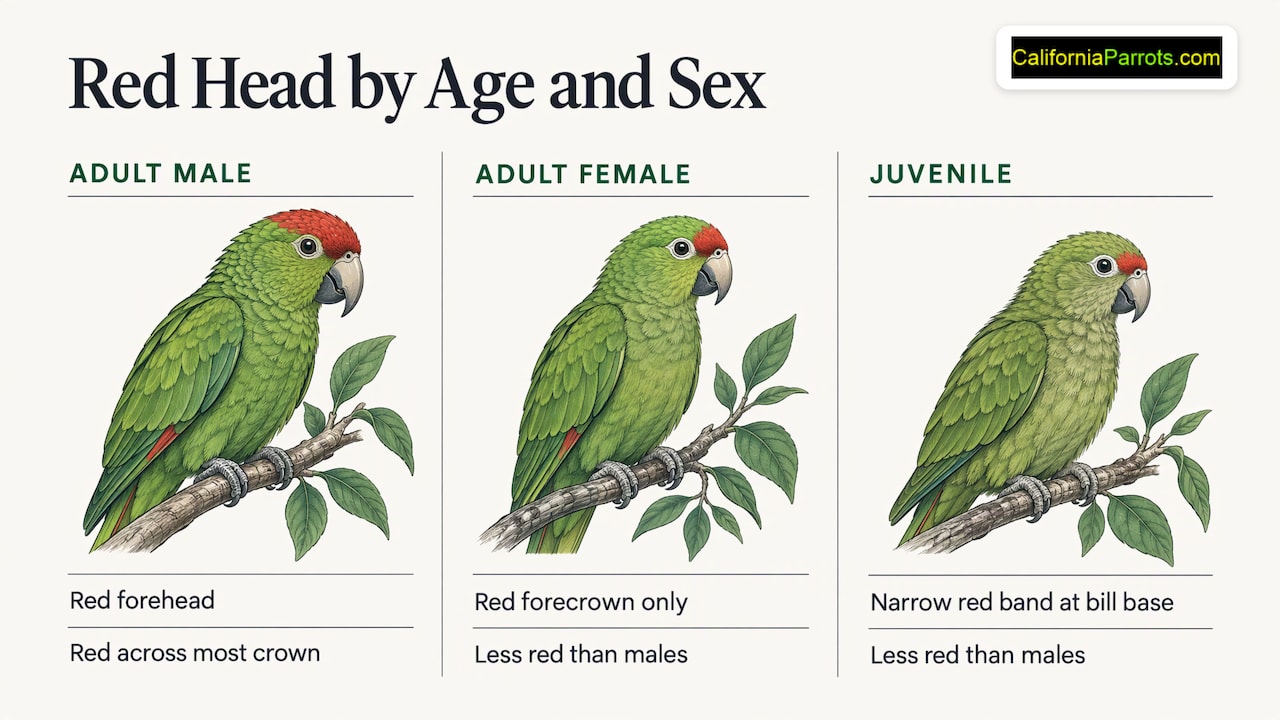
Not every red-crowned Amazon looks equally red. According to Cornell, adult females have red only on the forecrown, and juveniles have just a narrow band of red at the base of the bill. Audubon says the male has the red forehead and most of the crown, while females and young birds show less red. If you see a green parrot with only a small red patch on the front of its head, it can still be this species.
Identifying them by sound
These parrots are usually heard before they are seen. Audubon describes the flight call as a loud, ringing “heeeyo, cra-cra-cra”. In flight they move in fast, noisy groups, and Cornell reports they have been clocked at up to 27 miles per hour. The sound is often the first clue, and a quick look at the underwing and the red wing patch confirms it.
Our own red-crowned parrot page pairs this field information with photographs of the wild flocks we have documented over the years.
Yellow-crowned Amazon, lilac-crowned Amazon and the other “crowned” names
Many people searching for the red-crowned Amazon land on pages about yellow-crowned or lilac-crowned birds. The names are easy to confuse because all three are Amazon parrots with colored crowns. They are different species.
| Common name | Scientific name | Key marks |
|---|---|---|
| Red-crowned Amazon | Amazona viridigenalis | Red forecrown, bluish nape, yellow-green tail band, red wing patch |
| Yellow-crowned Amazon (yellow-crowned parrot) | Amazona ochrocephala | Yellow forehead and forecrown, red at the bend of the wing |
| Lilac-crowned Amazon | Amazona finschi | Lilac-colored crown and a maroon forehead |
The World Parrot Trust describes the yellow-crowned Amazon, also called the yellow-crowned parrot, as green with a yellow forehead and forecrown, red at the bend of the wing, and a white eye ring around an orange eye. It is a South American species, so it is a different bird from the red-crowned Amazon even when the two share a common name or a photo caption.
The lilac-crowned Amazon is the one most often mistaken for the red-crowned in Southern California, because both have a reddish front to the head. The lilac-crowned has a maroon forehead and a lilac crown instead of the red crown fading into blue. You can compare them on our lilac-crowned parrots page. A third Amazon, the red-lored parrot, also has red on the face, which adds to the confusion.
A practical way to sort them out in the field:
- Red patch on the crown fading to blue behind it: red-crowned.
- Maroon forehead with a lilac wash on the crown: lilac-crowned.
- Yellow on the forehead and crown: yellow-crowned.
- Red limited to the area between the bill and the eye: red-lored.
Lighting matters. In harsh sun or at dusk, crown colors can look darker or flatter than they are, so watch for the tail band and wing pattern as well as the head.
Native range and habitat
The red-crowned Amazon is native to Mexico. The U.S. Fish & Wildlife Service says it is currently found in northeastern Mexico, where it lives in arid lowlands and foothills, including gallery forests, deciduous woodlands and dry pine-oak woodland on ridges up to 3,281 feet (1,000 m). A gallery forest is a strip of tall trees that grows along a river or stream.
The species is not migratory, but it moves. A U.S. Fish & Wildlife Service assessment describes it as nomadic in winter, when large flocks range widely to forage, and very scattered in summer, when birds spread out in pairs. Large communal roosts, where flocks gather at night, are a defining feature of its social life.
Lifespan
Cornell says red-crowned Amazons may live 20 years or longer in the wild, while captive birds may live more than 50 years, even to 75. That longevity matters for conservation: these are slow-living birds, and losing adults to capture or habitat change is costly for a population.
An endangered bird that thrives in American cities
This is the part of the story most visitors do not expect. In its native range the bird is in trouble. In U.S. cities, it is doing well.
Why the species is endangered
BirdLife International’s species factsheet reports that in 1992 to 1994, densities in one area of northeastern Mexico were 5.7 birds per square kilometer, implying a wild population of 3,000 to 6,500 birds, compared with 25.2 per square kilometer in the 1970s. The same factsheet notes that field surveys and ecological models suggest the species has lost potentially 57% of its former distribution.
Two pressures stand out:
- Habitat loss. BirdLife reports that over 80% of the Tamaulipas lowlands have been cleared for agriculture, especially sorghum, and for pasture. Birds of the World adds that much of the native subdeciduous tropical forest and Tamaulipan thornscrub was lost in the 1960s and 1970s.
- Illegal capture for the pet trade. BirdLife estimates that illegal exports from Mexico, together with deaths before export of over 50%, equate to about 5,000 birds a year. It also records that 16,490 birds were legally imported into the United States between 1970 and 1982.
That trade is the reason the species exists in American cities at all.
How the birds reached California
Birds of the World states that naturalized populations totaling in the thousands of birds now exist in southern California, Florida, Puerto Rico, Hawaii and urban areas of Mexico, including Monterrey, all descended from escaped or released pet-trade birds. In Southern California, the flocks became established in cities over the past several decades. You can read the full background in our guide to where the wild parrots came from and the additional events that shaped the flocks.
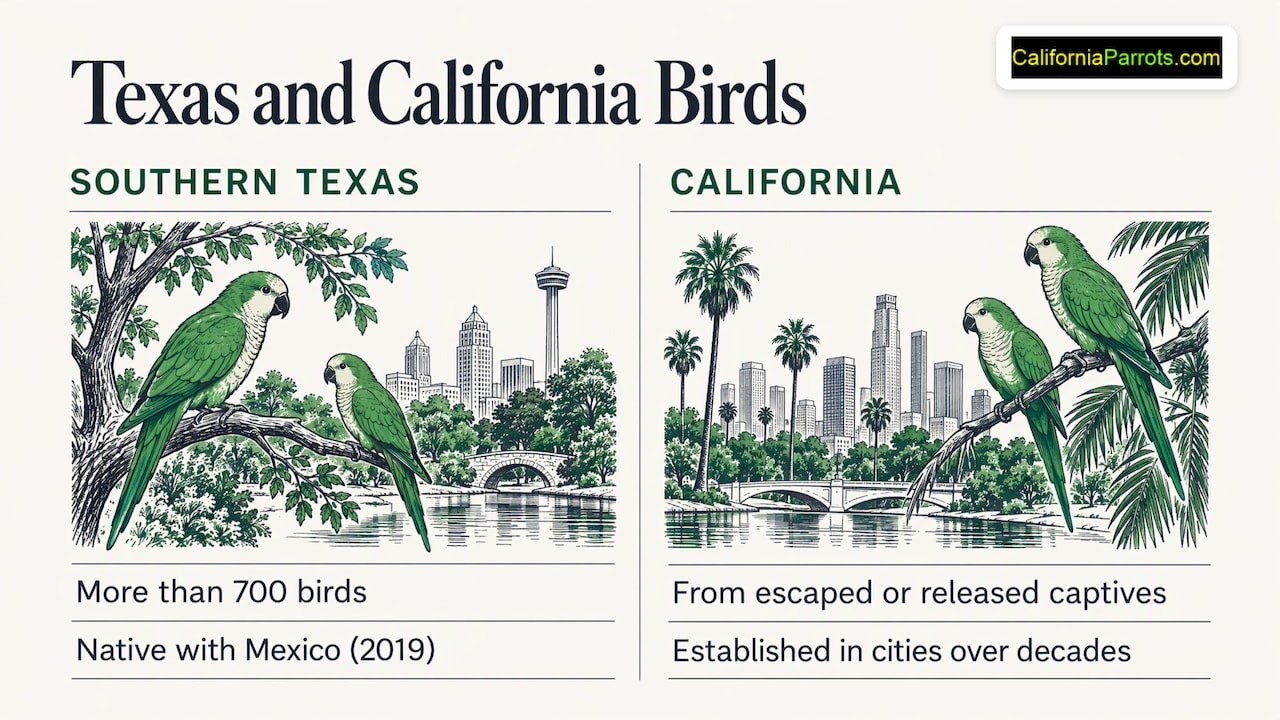
It is worth noting that the same literature treats the U.S. populations differently by region. Cornell reports that more than 700 red-crowned Amazons live in southernmost Texas, and that in 2019 the U.S. Fish and Wildlife Service said it considers the species native to Texas as well as Mexico. California’s birds, by contrast, descend from escaped and released captives.
Why cities suit them
Birds of the World explains that over the last four decades the species has occupied a novel niche in suburban and urban landscapes, where a mix of native and non-native vegetation provides food and roosting sites. A 2023 Texas A&M doctoral thesis by Simon Kiacz found a healthy, growing population in south Texas that relies heavily on urban and suburban areas, and noted similar urban dependence in Southern California and Florida.
For anyone who has watched flocks over many seasons, this fits what the birds do day to day: they follow fruiting and flowering trees through the year, gather at dusk in noisy roost trees, and spread out across neighborhoods in the morning. Their lives are tied to the choices cities make about mature trees.
What the urban flocks mean for conservation
Scientists do not agree on one neat verdict, and the range of views is part of what makes the species interesting for students.
- A genetic reservoir. Kiacz’s dissertation argues that naturalized populations of threatened parrots could represent valuable genetic reservoirs and, in highly modified habitats, may help offset biodiversity loss caused by urbanization.
- An irony. Audubon frames it as an irony: on its limited native range the species has declined seriously and might be considered threatened, while escaped birds fly free in Florida and California.
- Native-range conservation still comes first. Birds of the World’s authors note that success in naturalized populations has reduced the urgency of management actions in the native range, yet conservation in northeastern Mexico remains paramount.
The 2023 thesis also identifies threats to the urban populations: poaching and hybridization with other naturalized Amazon parrots. It concludes that management actions may be needed to ensure the genetic integrity of the threatened population. Hybridization means a red-crowned Amazon pairing with a different Amazon species, which produces birds that blur the lines between species. That is one more reason accurate identification matters: good records of who is where help researchers track it.
Legal status in the United States
Cornell notes that because the red-crowned Amazon was not mentioned in the Migratory Bird Treaty Act of 1918, it does not receive federal protection under that act. Wild parrots are best watched from a distance and left undisturbed, and taking wild birds is a conservation problem in its own right.
Watching wild red-crowned Amazons responsibly
You do not need special equipment, but a few habits make the experience better for you and safer for the birds.
- Listen first. Learn the loud flight call, then scan the sky and treetops.
- Look at the timing. Flocks tend to be most active and vocal at dawn and dusk, when they travel between feeding areas and roost trees.
- Use binoculars. Check the red crown, the blue nape and the wing patch, so you can separate the species from other Amazons.
- Keep your distance. Never feed, chase or try to handle wild birds.
- Note what you see. Record the date, the number of birds and the colors you noticed. Good notes are the foundation of local knowledge.
Explore the wild flocks in photos
Our site is dedicated to the wild Amazon parrots of Southern California, built on years of daily observation and documentation of the local flocks. If you want to see the red crown, the blue nape and the wing patch in real photographs, start with our Wild Parrots Gallery, where the images sit alongside species information and personal observation notes.
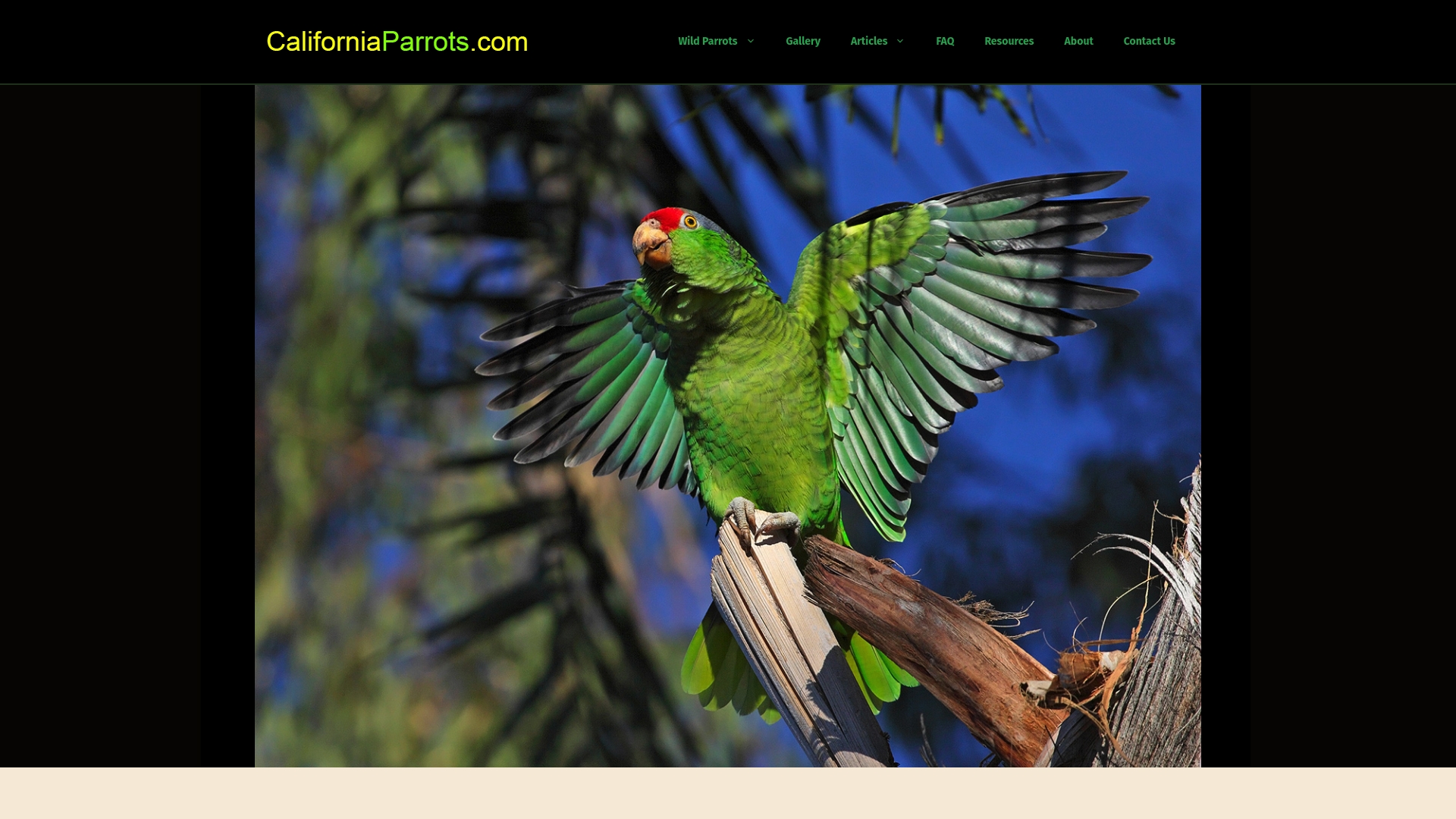
For the full species write-up, visit our red-crowned parrot page, or browse the Wild Parrots hub for the other Amazons living in Southern California.
FAQ
How long does a red-crowned parrot live?
Cornell says red-crowned Amazons may live 20 years or longer in the wild. Captive birds may live more than 50 years, with some reaching 75. Those figures come from the Cornell Lab’s species overview.
What kind of parrot has a red head?
In Southern California, the most common answer is the red-crowned Amazon, a green parrot with a red forecrown and a bluish nape. Females and young birds show less red. Other Amazons also show reddish color on the face or crown, so check the nape, the tail band and the wing patch to be sure.
Is a yellow-crowned Amazon the same as a red-crowned Amazon?
No. The yellow-crowned Amazon (Amazona ochrocephala) is a separate species with a yellow forehead and forecrown, according to the World Parrot Trust. The red-crowned Amazon (Amazona viridigenalis) has a red crown that fades into blue.
Are red-crowned Amazons endangered?
Yes, in their native range. BirdLife’s factsheet reports a wild population of roughly 3,000 to 6,500 birds in northeastern Mexico based on 1992 to 1994 densities. Habitat clearing and illegal capture are the main pressures. Naturalized flocks in U.S. cities now number in the thousands.
Where do the California birds come from?
They descend from escaped or released captive birds. Birds of the World states this about all naturalized populations of the species, and our history of the flocks covers the Southern California story in more detail.
Sources
- Red-crowned Amazon Identification, All About Birds (Cornell Lab of Ornithology)
- Red-crowned Amazon Overview, All About Birds (Cornell Lab of Ornithology)
- Red-crowned Amazon, U.S. Fish & Wildlife Service
- Species Assessment, U.S. Fish & Wildlife Service (2014)
- Red-crowned Amazon, Audubon Field Guide
- Red-crowned Amazon, Birds of the World
- Status, Distribution, and Population Modeling of Red-crowned Parrots, Texas A&M (2023)
- Red-crowned Amazon species factsheet, BirdLife DataZone
- Yellow-crowned Amazon, World Parrot Trust