
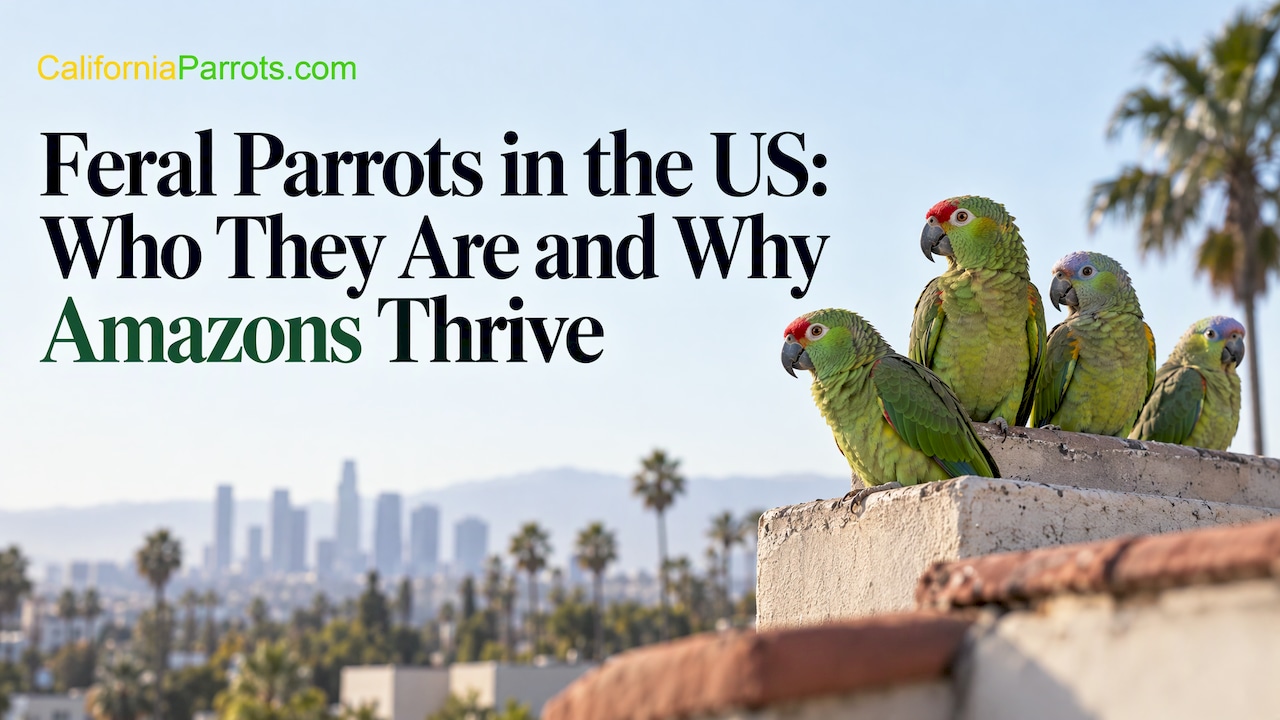
Feral parrots are parrots descended from escaped or released pets that now live and persist in the wild outside their native range. Scientists often prefer the term “naturalized”. In the United States, the best-documented case is the Amazon parrots of Southern California. Their story shows how a bird can disappear from its homeland and still survive in a city thousands of miles away. We have watched local Amazon flocks for years, and this guide explains what the science says and what the birds’ lives look like.
Key Takeaways
- “Feral” is the everyday word, but researchers usually say “naturalized” for self-sustaining parrot populations that came from the pet trade.
- Dozens of parrot species have been seen in the wild in the contiguous US, and close to half have established populations, mostly in warm climates and cities.
- In Southern California the Red-crowned and Lilac-crowned Amazons dominate, with more than 3,000 and about 800 birds respectively in a recent estimate.
- Documented ecological harm is minor, yet the Red-crowned Amazon is endangered in Mexico, which gives these city flocks real conservation interest.
Table of Contents
- What “feral parrot” actually means
- How many feral parrot species live in the US?
- Feral parrot populations: the Amazon story in California
- Why Amazon parrots do well in American cities
- Are feral parrots harmful?
- Are any parrots native to the United States?
- The conservation twist: city flocks of an endangered bird
- Explore the California Amazons with us
- FAQ
- Sources
What “feral parrot” actually means
Strictly speaking, “feral” describes a domesticated animal that has gone wild, like a feral cat. Parrots sold as pets are not domesticated in that sense. They are wild-type birds that were captured, sold and later escaped or were let go. That is why a 2023 study of parrots in the US prefers “naturalized” even though “feral” is widely used.
The same study separates three terms that often get mixed up:
| Term | Meaning |
|---|---|
| Introduced | The species is living outside its native range |
| Naturalized | The introduced population sustains itself over time |
| Invasive | The population spreads and causes harm |
Most parrots that people call feral in the US belong in the middle row. They are introduced and self-sustaining, but they have not been shown to cause major harm. A “wild parrot” in Southern California is therefore not a native bird. It is a wild bird in a place it was never expected to live.
How many feral parrot species live in the US?
The number depends on who counts and how.
- A 2021 review of public databases counted 28 naturalized parrot species in the continental US, Hawaii and Puerto Rico.
- The 2023 study recorded 73 parrot species observed in the contiguous states, with close to half having established populations.
- A 2019 analysis of nearly 120,000 community-science sightings from 2002 to 2016 found 56 species in 43 states, with 25 of them established in 23 states.
These figures differ because the studies cover different places, years and definitions. A seen bird is not the same as a settled population, and a settled population is not the same as a count of individuals. None of these are censuses of how many parrots exist.
Two patterns hold across them. The 2023 study says naturalized populations sit mainly in warm climates and urban areas. And the 2019 survey reported that Florida, California and Texas lead the country in sightings. The Red-crowned Amazon was one of the three most frequently reported species in that survey.
On this site we cover only the Amazon parrots. In California that means two species, the Red-crowned Amazon and the Lilac-crowned Amazon. Both come from Mexico, and both now live as free-flying city birds in Southern California. For a species overview, see our page on wild parrots in Southern California.
Feral parrot populations: the Amazon story in California
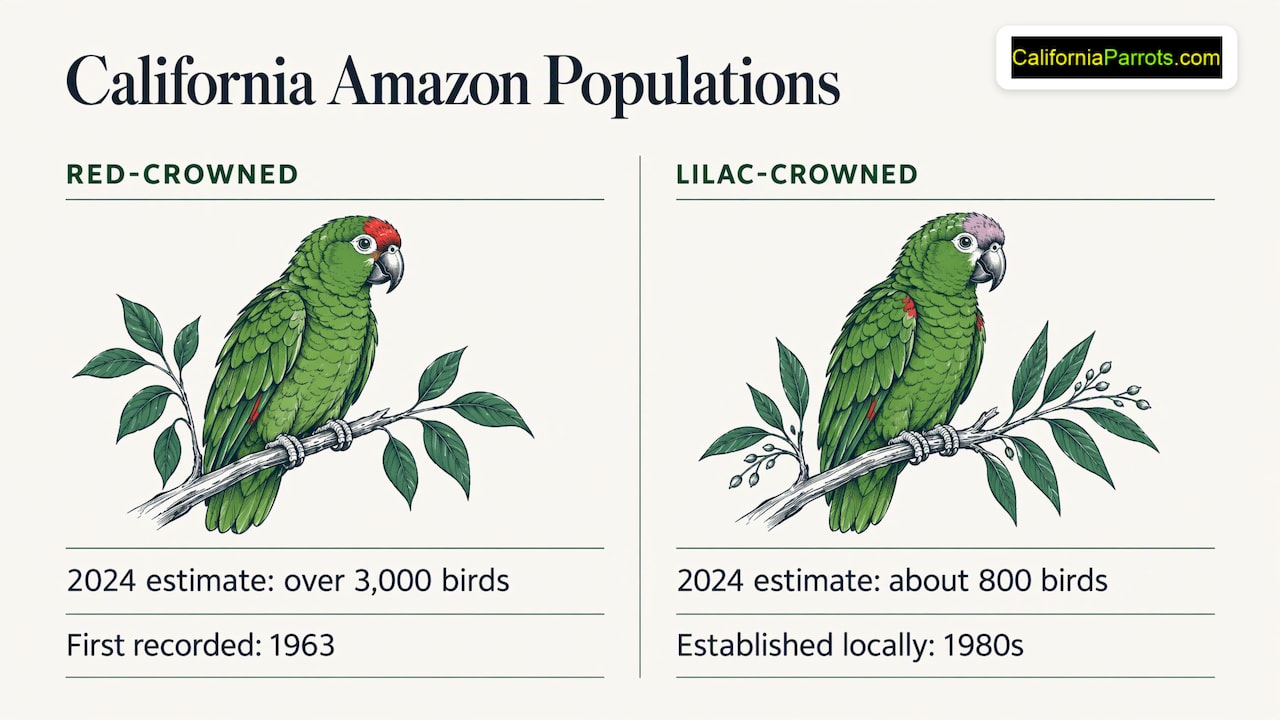
Both Amazon species are Mexican natives. The Los Angeles Times reported that Red-crowned Parrots were first recorded in the Los Angeles area in 1963, and that Lilac-crowned Parrots became established locally in the 1980s.
A 2024 study covered by the same paper estimated the local Red-crowned population at over 3,000 birds and the Lilac-crowned at about 800. These are species-specific estimates for one region, and counts shift as birds are surveyed again, so treat them as a snapshot of that study period.
How did they get here? The short version is the pet trade. Birds that were captured, imported and sold sometimes escaped or were released. Enough of them survived and stayed together to form lasting groups. Ornithologist Stephen Pruett-Jones has explained that a population only becomes naturalized once enough birds of a species are present to find each other and persist. A single escaped bird is a story. A flock that is still around decades later is a population.
There is no single origin event. Our pages on where the wild parrots came from and the other events that shaped the flocks walk through the accounts we have collected from long-time observers.
Why Amazon parrots do well in American cities
Southern California is dry, and the native range of these birds is not the same as a Los Angeles neighborhood. Yet the birds thrive. The 2024 study reported by the Los Angeles Times points to artificial irrigation and urban landscaping as the reasons the two Amazons do well despite the dry climate. In other words, a city that waters and plants like a subtropical garden can look a lot like the habitat the birds left behind.
Some traits help the flocks cope with city life:
- Warm climate. Naturalized parrots cluster in mild regions, and Southern California suits Amazons that come from a warm country.
- Group living. These are social birds. Flocks travel, roost and move together every day, which helps individuals keep track of their surroundings.
- Loud, constant communication. The calls that make a flock easy to identify overhead also keep the group together across a busy cityscape.
- Flexibility. Urban habitat is patchy. Birds that adjust their daily routes to streets, parks and gardens do better than those tied to one site.
If you watch a flock at dusk, you will often hear the birds before you see them. Flocks pass overhead in noisy groups, and experienced observers can tell the two species apart by a few markings and the sound of the calls. Our Red-crowned Amazon guide covers identification, range and conservation in more detail, and the Red-crowned Parrot page adds more about the species.
Are feral parrots harmful?
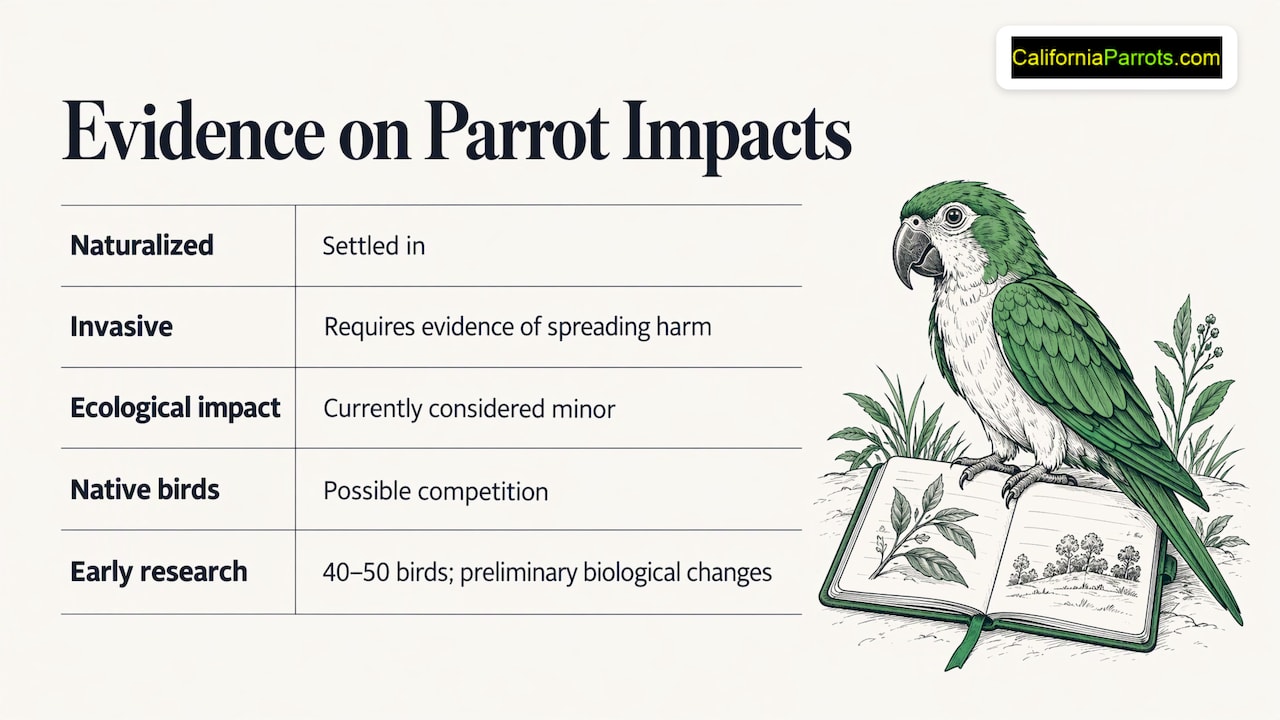
People often assume that any introduced species is a problem. For parrots, the evidence is more modest. The 2023 study concludes that naturalized parrots may compete with native birds, but that their current ecological impacts are considered minor. It does note that their calls can be disruptive to neighbors.
The National Wildlife Federation reported that early fears of crop damage and displacement of native birds had not been realized in the cases it reviewed. That is consistent with the more careful term. “Naturalized” describes a bird that has settled in. “Invasive” would require evidence of spreading harm.
There is also early research on how the two California Amazon species are changing. The Guardian reported in 2025 that Los Angeles researchers examining the two species had found biological and genetic changes in preliminary analyses of 40 to 50 birds. This is emerging work. It shows scientists are interested in these flocks as a study subject, and it does not show any damage to the ecosystem.
Are any parrots native to the United States?
Not today. The 2023 study states that the contiguous United States currently has no endemic parrot species. Every parrot you see flying free in a US city is there because of people, whether through the pet trade or a release.
That is why the “wild” in “wild parrots” needs a footnote. These birds live wild, and they are not native. The Amazons in California come from Mexico, and that fact leads to the most interesting part of the story.
The conservation twist: city flocks of an endangered bird
Neither species is a nuisance back home. Both are birds under pressure. The Red-crowned Amazon is endangered in its native range in Mexico, where habitat destruction and illegal trapping for the pet trade are among the threats.
That creates an unusual situation. The same trade that moved the birds to California also helped drive them toward decline in their homeland. The flocks in Southern California are descendants of that trade, and they may now hold a meaningful share of the world’s Red-crowned Amazons. Ornithologist Bill Pranty, quoted by the National Wildlife Federation, noted that urban colonies of threatened Mexican parrots could potentially contribute to future conservation or reintroduction, provided illegal trafficking is stopped and plans are made carefully.
This is why we think the label matters. Calling these birds only “feral” or “escapees” hides their value. Calling them naturalized, and paying attention to their status at home, gives a fuller picture.
What you can do as a reader
You do not need special equipment to take part.
- Watch from a distance. Observe flocks without approaching or disturbing them, and keep a respectful distance from neighbors’ property.
- Learn the two species. Knowing a Red-crowned from a Lilac-crowned Amazon makes your observations more useful and more fun.
- Keep records. Note date, group size and behavior. Consistent notes over months tell you more than a single sighting.
- Be careful what you share. Discuss the birds in general terms and avoid publishing exact spots, which can invite crowds or worse.
- Say no to the wild-bird trade. Illegal trapping is one of the pressures on the species in Mexico, so never buy a bird of uncertain origin.
Explore the California Amazons with us
We built this site around years of daily observation of Southern California’s wild Amazons. It combines species guides, conservation context and personal accounts from the people who have followed these flocks the longest.
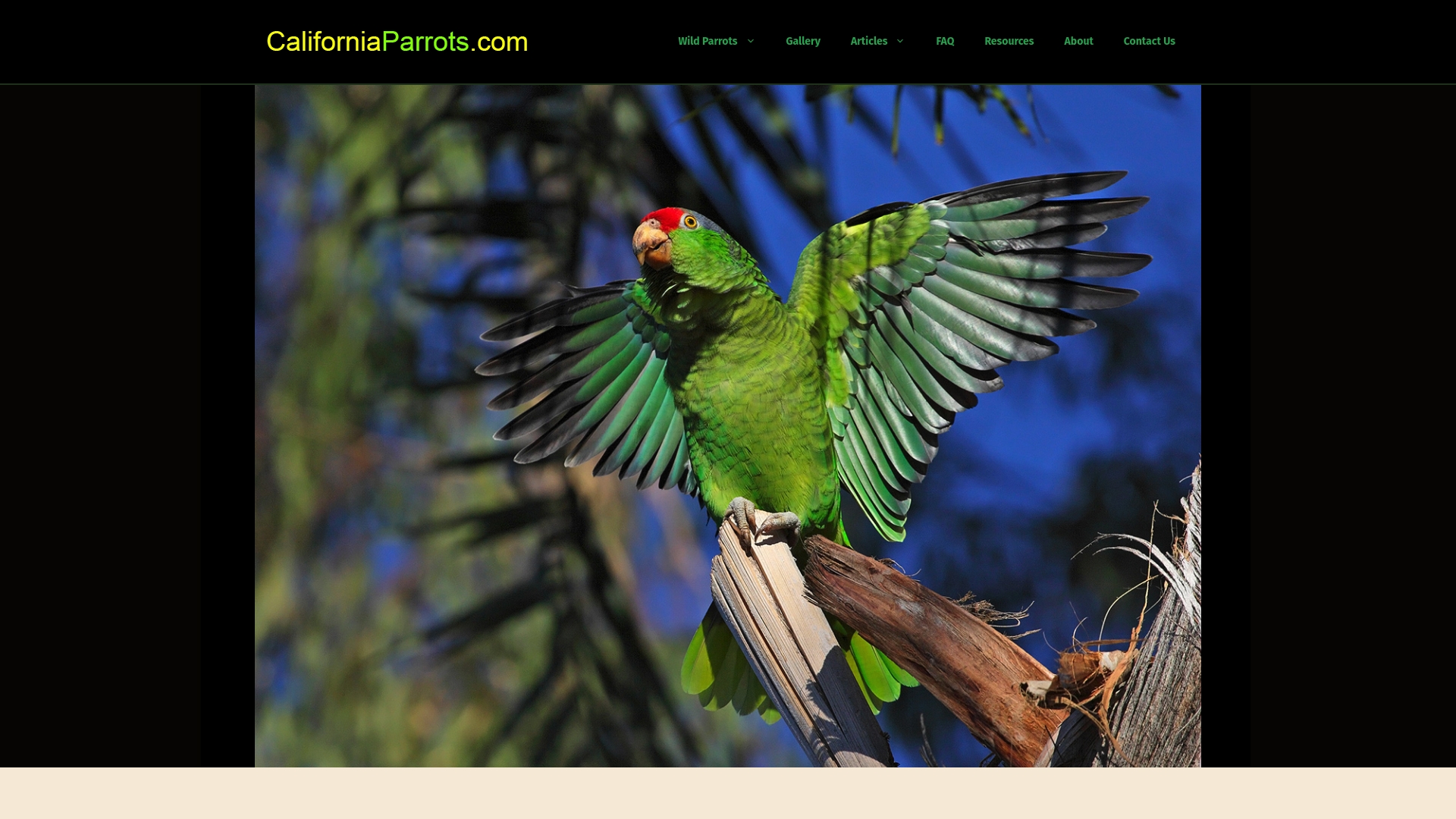
If you want to see the birds up close, start with our wild parrot photo gallery. For the full picture of the species, origins and survival, read Wild Parrots in Southern California, or browse more articles on the site.
FAQ
Are feral parrots the same as wild parrots?
In everyday use, yes. Scientists prefer “naturalized” for parrots that came from the pet trade and now sustain themselves. A feral animal is strictly a domesticated one gone wild, and parrots are not domesticated. The birds are wild-type and live on their own.
Which feral parrot species live in Southern California?
The two Amazons covered here are the Red-crowned Amazon and the Lilac-crowned Amazon. A 2024 estimate reported by the Los Angeles Times put the Red-crowned population above 3,000 and the Lilac-crowned at about 800. Both are native to Mexico.
Are feral parrots a problem for native wildlife?
Current evidence says the impact is small. A 2023 study notes parrots may compete with native birds but considers their ecological effect minor, though their calls can be loud. Researchers continue to study how the birds change over time.
Are any parrots native to the US?
No. The contiguous United States has no endemic parrot species today. The parrots living free in American cities are descendants of birds that escaped or were released from captivity.
Is the Red-crowned Amazon endangered?
In its native range in Mexico, yes. Habitat destruction and illegal trapping for the pet trade are among the pressures, according to a field guide to the feral parrots of the US. That is part of why the California flocks draw conservation interest.
Sources
- Patterns and Factors Influencing Parrot Establishment in the United States (2023)
- The Number and Distribution of Introduced and Naturalized Parrots (2021)
- Exotic Parrot Colonies Are Flourishing Across the Country (Audubon, 2019)
- Feral Mexican parrots thrive on exotic L.A. landscaping (Los Angeles Times, 2024)
- Stephen Pruett-Jones on Naturalized Parrots of the World
- Parrots Living Wild in American Cities (National Wildlife Federation, 2008)
- A Guide to The Feral Parrots of the US (The Nature Conservancy)
- These parrots came to Los Angeles as pets, then went wild (The Guardian, 2025)