
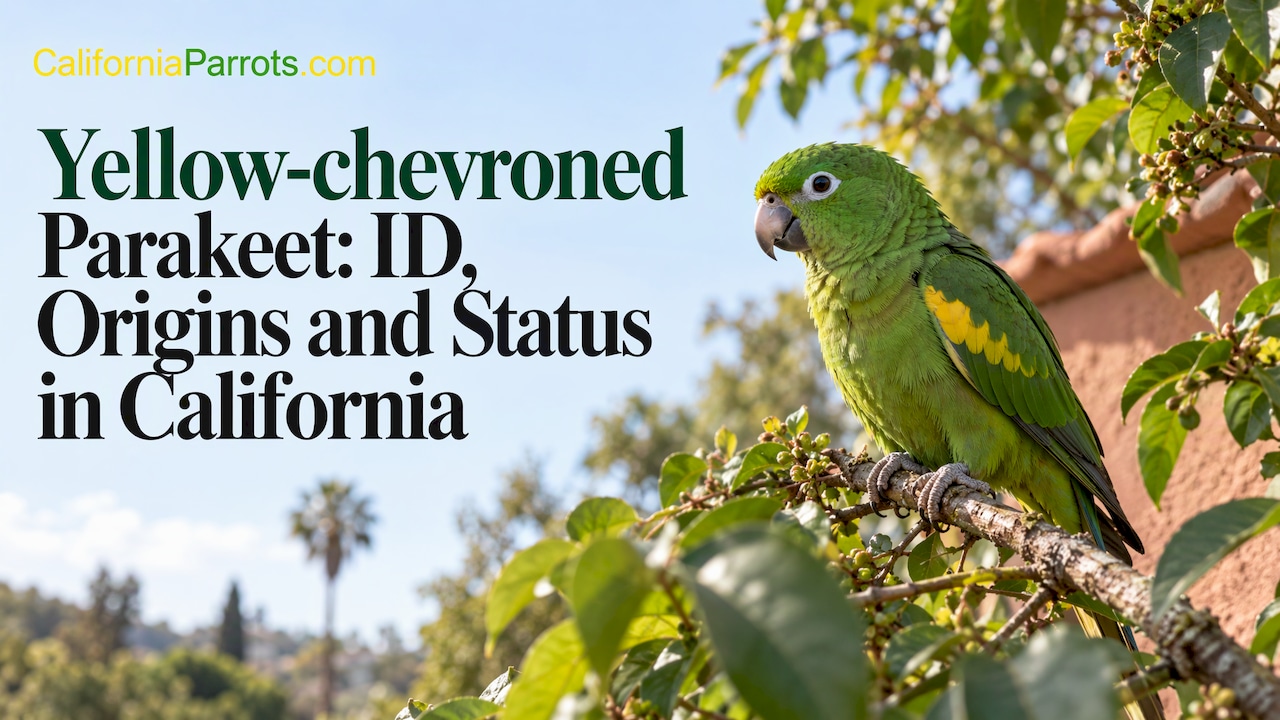
The yellow-chevroned parakeet (Brotogeris chiriri) is a small, slim, mostly green parrot named for the yellow band along its folded wing. It is native to South America and now lives wild in parts of Southern California, descended from escaped or released pets. It is also one of the most frequently confused birds in the state’s urban parrot scene. This guide covers how to recognize it, where it comes from, how it got here and what its conservation story looks like, so you can read a flock overhead with confidence.
Our site is devoted to California’s wild Amazon parrots, and years of daily observation have taught us how much first-time watchers mix up what they see. Knowing the parakeet’s field marks is the quickest way to know what you are not looking at.
Key Takeaways
- The yellow-chevroned parakeet is a small green parrot, 8 to 10 inches long, with a pointed tail, dark blue wingtips and a yellow stripe across the wing.
- It is native to tropical South America and reached California through the pet trade, after tens of thousands of birds were imported to the US in the late twentieth century.
- Globally it is not threatened, but trapping for trade is a documented pressure, and its California numbers have recently fallen sharply.
- Its call is a short squawk and chatter, and it is loudest in flight, which makes sound a useful clue.
- Reliable counts are hard to get, so careful, honest reports from ordinary observers add real value.
Table of Contents
- What is a yellow-chevroned parakeet?
- How to identify it in the field
- Where the species comes from
- How it came to California
- Conservation status and threats
- Why the numbers are hard to pin down
- A practical routine for getting it right
- Common questions about the name and the species
- Where this species fits in the story of California’s wild parrots
- Keep learning with California Parrots
- FAQ
- Sources
What is a yellow-chevroned parakeet?
A chevron is a V-shaped or banded mark, and the name describes the yellow edge on the bird’s wing. The Audubon Field Guide describes a small parakeet with a pointed tail, mostly pale green plumage, dark blue wingtips and a yellow stripe across the wing. Males and females look alike, so you cannot sex a bird by eye.
It is a modest bird in size. Audubon lists a length of 8 to 10 inches (20 to 25 cm), a wingspan of 14 to 16 inches (35 to 41 cm) and a weight of 2.5 to 3.5 ounces (70 to 100 g). That is lighter than a hefty apple. Picture a slender, long-tailed green bird rather than a bulky, big-headed one.
People often ask whether yellow parakeets exist, because the search results throw up a mix of pet-trade color varieties and wild species. In the wild, this is the species that earns the “yellow” in its name, but the color is an accent on a green bird, not an all-yellow plumage. If a bird in a California neighborhood is solid yellow, you are looking at a pet, not a wild flock member.
How to identify it in the field
Identification works best when you stack several clues rather than relying on one. Here is the sequence we use.
1. Size and shape
Start with the silhouette. The yellow-chevroned parakeet is small, with a long pointed tail that trails behind it in flight. Birds that look chunky, large-headed and short-tailed are a different story, and our pages on the Red-crowned Amazon show what the larger Amazon silhouette looks like.
2. The wing
The namesake mark is the yellow stripe across the wing, set against dark blue wingtips. When the bird is perched with its wings folded, the yellow can be hard to see from certain angles, so do not rule it out because you caught only the back or a side view. Wait for the bird to fly or shift position.
3. Face and bill
Cornell’s species account for the bird, summarized on its Birds of the World introduction page, covers the species in depth. In the field, look for a short pale bill and a narrow pale ring around the eye. The Delaware Valley Ornithological Club’s field notes describe a deep, flesh-pink bill and a clean white eye-ring, with green feathering between bill and eye.
4. Voice
Sound is often the first clue. Audubon describes short squawks and a chatter, noisy and nearly constant in flight but quieter once a flock settles. The DVOC notes describe a higher, scratchy, metallic “chiri-chiri” call, which also gives the species its scientific epithet. If you hear a thin, rapid, metallic chatter pass overhead, look up for small birds with trailing tails.
5. Group behavior
The species is highly social. Birds of the World says they travel, roost and move in groups, with pairs staying together almost continuously. A single parakeet is unusual, and a pair within a larger flock is typical. The World Parrot Trust reports large flocks and communal roosts that can reach several hundred birds.
Here is a quick comparison to keep in your notes.
| Clue | Yellow-chevroned parakeet | What to check on any other green parrot |
|---|---|---|
| Length | 8 to 10 in (20 to 25 cm) | Is the bird clearly bigger and stockier? |
| Tail | Long and pointed | Is it short and squared or rounded? |
| Wing | Yellow stripe, dark blue wingtips | Look for the color on the wing, in flight if possible |
| Voice | Squawks and metallic chatter, loudest in flight | Does the call sound deeper and more raucous? |
| Group | Noisy, social flocks | Does the group split into pairs? |
If you are comparing a bird with the Amazons that dominate our pages, the Parrot Gallery is a good place to build your visual memory before you head out.
Where the species comes from
The yellow-chevroned parakeet is a South American bird. Audubon places it in tropical South America east of the Andes and south of the Amazon. The World Parrot Trust gives a more detailed range: one subspecies (B. c. chiriri) occurs in northern and eastern Bolivia, Paraguay, northern Argentina and much of Brazil south to São Paulo, while the other (B. c. behni) lives from central and southern Bolivia to northwestern Argentina.
Its habitat there is varied. The same source lists moist and seasonal forests, riparian and gallery forests, the Pantanal wetlands, savannas and even city parks, mostly below 1,000 meters and locally up to 2,500 meters. That flexibility explains a lot about its success in cities abroad. A bird that already tolerates parks and settlements in its homeland has a head start in Los Angeles.
How it came to California
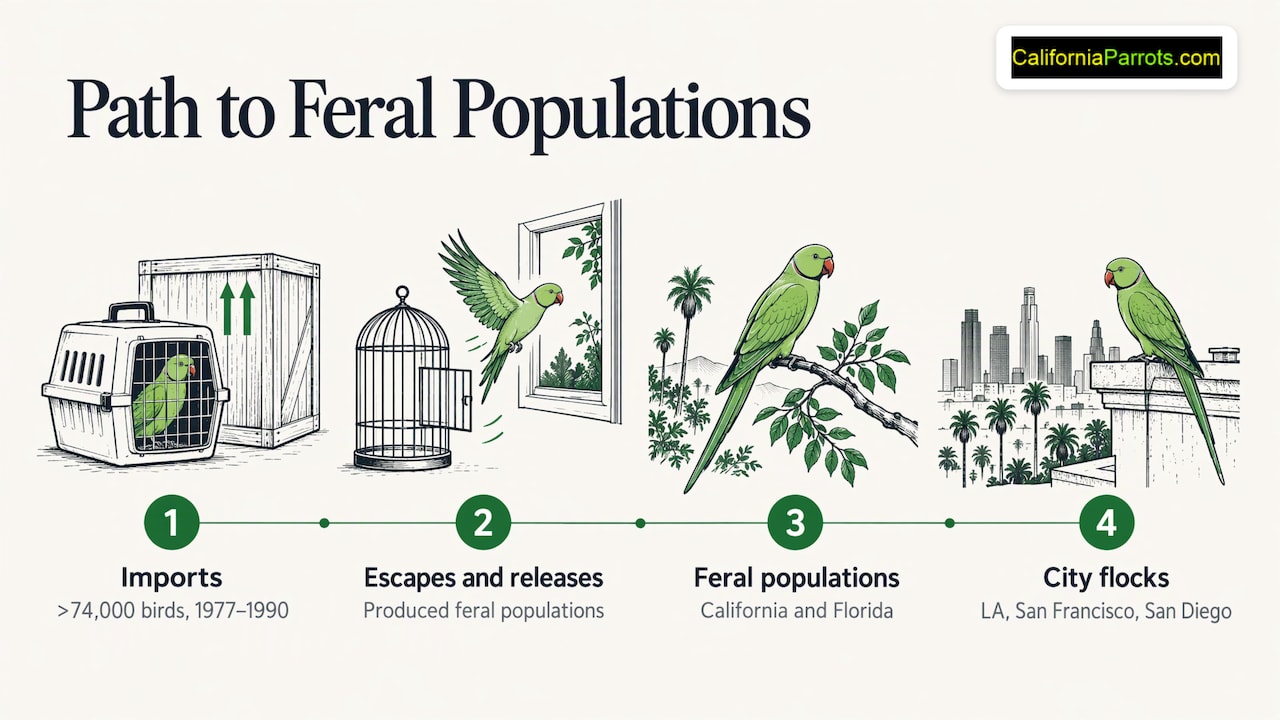
The story is the same one that explains most of the state’s wild parrots: the pet trade. According to Birds of the World, more than 74,000 yellow-chevroned parakeets were imported into the United States between 1977 and 1990. Escapes and releases then produced feral populations in California and Florida.
That matches what we describe in Where Did the Wild Parrots Come From?, where several overlapping events, not one dramatic release, built the flocks we see today. A 2019 field guide published by The Nature Conservancy reports that this parakeet has established colonies amid Los Angeles’s skyscrapers and sprawl, and that Los Angeles, San Francisco and San Diego host feral parrot populations.
The present-day picture is more nuanced. Birds of the World reports that Florida’s populations appear stable or slightly increasing, while California numbers have decreased dramatically in recent years. Even that statement carries caution, which we turn to below.
If you share your home with a pet bird, the lesson from this history is simple: escapes are how wild populations start, and secure handling matters. Planning moving a pet bird safely is one practical way to prevent a lost bird, including on routine trips to the vet.
Conservation status and threats
The headline is reassuring. The World Parrot Trust states that the species is not globally threatened and is fairly common. Its native range is large, and the bird copes with habitat change near settlements.
That does not mean it faces no pressure. The same source identifies trapping as a threat, with more than 76,000 individuals recorded in trade. Birds of the World adds that in parts of its native range the species is regarded as an agricultural pest, which can bring conflict with farmers, and that its southern populations appear to be growing, so closer monitoring could be worthwhile.
This is the part that matters for anyone who cares about conservation. A bird can be “fairly common” overall and still be shaped by human demand, by trade and by changing land use. The history of California’s flocks is itself a result of trade. That is also why we focus on the Amazon parrots in our own pages, many of which face far graver risks in their native countries. Our overview of feral parrots in the US explains why some species thrive in cities while their wild relatives decline at home.
Is the yellow-chevroned parakeet a problem for California? Reporting by The Guardian on Los Angeles’s wild parrots says they are not considered invasive. In that coverage they are described as having almost no predators, and as not competing with local birds for food, since they rely almost entirely on imported ornamental plants. Vorstman’s regional guide also notes no reported agricultural damage in the United States, which fits that picture.
Why the numbers are hard to pin down
If you read that the species is declining in California, it helps to know how fuzzy the data are. Birds of the World explains that trends for introduced yellow-chevroned parakeets are difficult to measure, for two reasons. Annual winter bird counts cover introduced species unevenly, and many US observers log both members of this parakeet group under one catch-all name. It adds that most of the species’ basic biology is still anecdotal.
For a student of environmental science, that is a useful lesson in how monitoring works. Counts depend on who is looking, where and with what skill. A decline on paper can reflect fewer birds, fewer observers or more careful identification.
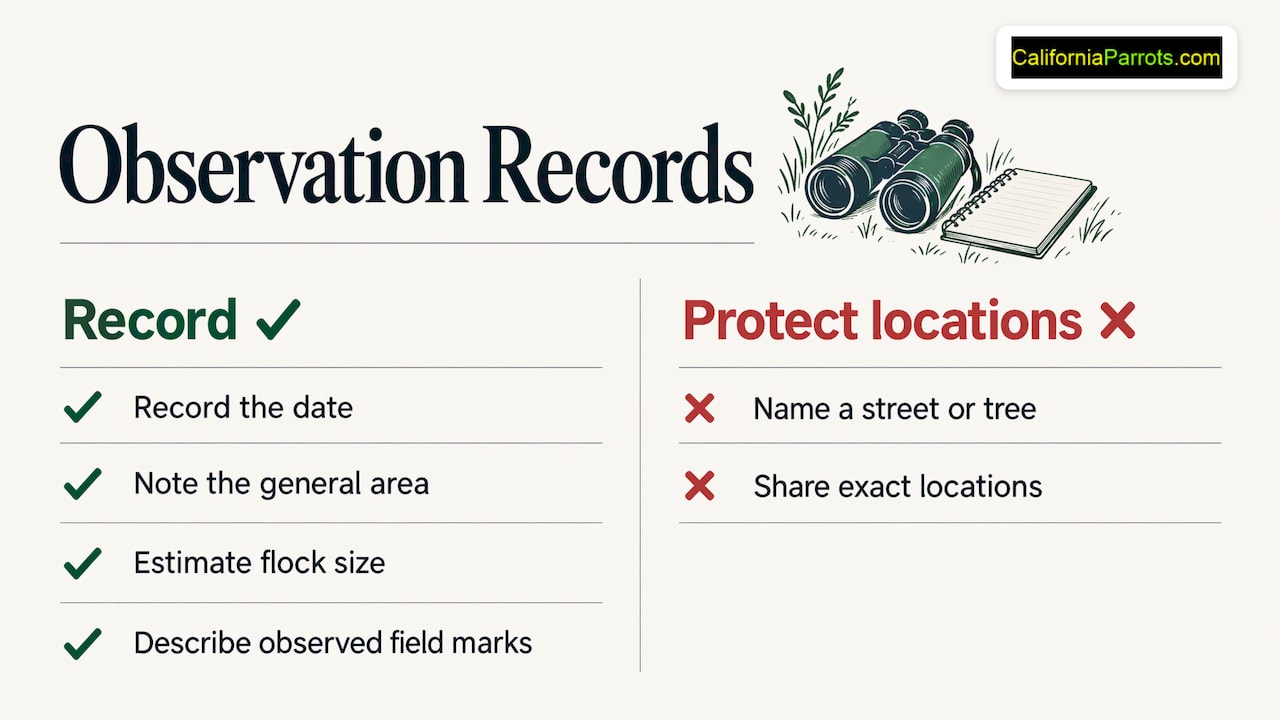
For a bird watcher, it is an invitation. Reports that carry a date, a general area, a flock size estimate and the specific field marks you saw are worth far more than a bare “parakeet” entry. You do not need to name a street or a tree. A region and a description are enough, and keeping location details general also protects the birds.
A practical routine for getting it right
Here is how we suggest you approach an unfamiliar flock.
- Listen first. Note the quality of the call. Thin, fast, metallic chatter points to small birds. Deeper, harsher shouting points elsewhere.
- Judge size against something familiar. A parakeet is far lighter than a pigeon-sized bird, at 2.5 to 3.5 ounces.
- Watch the tail. Long and pointed is your anchor feature.
- Wait for the wing. The yellow stripe and dark blue wingtips show best when a bird stretches, preens or takes off.
- Photograph from several angles. One angle can hide the yellow stripe. A set of images lets you or someone else confirm the identification later.
- Record the context. Date, time of day, weather, approximate flock size and the general area (city or neighborhood is enough).
- Compare with reference images. Our wild parrot photo gallery helps you train your eye for the larger Amazon silhouettes that share Southern California’s skies.
The point of this routine is not to prove you are right in the field. It is to make your notes useful to you next week and to anyone who reads them later.
Common questions about the name and the species
The scientific name Brotogeris chiriri is easy to mispronounce, but the common name is the one most people search. Because there are close relatives in the same genus, you will see older and newer names mixed together online, and bird lists do not always agree on which label applies. That is another reason to describe what you saw, not only the label you chose.
The name “chevroned” is the clue to remember. If you can see a yellow band on a green wing, you have the field mark the bird is named for. If you cannot see it, treat the identification as provisional and note the other clues you recorded.
Where this species fits in the story of California’s wild parrots
The yellow-chevroned parakeet shows how a pet-trade import turns into a city resident. It also shows how limited our knowledge can be when a species is small, fast and widely misreported. The Amazon parrots we focus on tell a similar story at larger scale, and one with higher conservation stakes, because the Amazons that thrive in Southern California descend from birds whose wild populations are in trouble in their native countries.
Our guide to wild parrots in Southern California lays out those species, their origins and how they survive in urban settings. If you came here for one parakeet, it is worth reading alongside it, because the same questions apply: how did they get here, how are they doing, and what can an observer contribute?
Keep learning with California Parrots
We have spent years documenting California’s wild Amazon parrots, and our galleries, species guides and observation stories are free to read. Start with the Parrot Gallery to see the birds we cover, then use our FAQ for quick answers about origins, status and responsible watching.
If you want the full picture of how feral parrots came to thrive in American cities, begin with our home page at California Parrots and follow the links to the species that interest you most.
FAQ
Are there yellow parakeets in the wild?
Yes, but the yellow is an accent. The yellow-chevroned parakeet is mostly pale green with a yellow stripe across the wing, according to Audubon. A bird that is yellow all over is almost certainly a pet.
How big is a yellow-chevroned parakeet?
It measures 8 to 10 inches (20 to 25 cm) long, with a wingspan of 14 to 16 inches and a weight of 2.5 to 3.5 ounces, per the Audubon Field Guide. Its long pointed tail makes it look slimmer than its length suggests.
Is the yellow-chevroned parakeet endangered?
No. The World Parrot Trust states that it is not globally threatened and is fairly common, though trapping for trade is a recorded pressure. In California, numbers have recently dropped, according to Birds of the World.
Is it an invasive species in California?
Coverage of Los Angeles’s wild parrots by The Guardian says they are not considered invasive. They have almost no predators and do not compete with local birds for food, since they rely on imported ornamental plants.
Why is it so hard to count?
Winter bird counts cover introduced species unevenly, and many observers report two similar parakeets under one name, so trends are difficult to measure. Clear, detailed observations help fill that gap.
Sources
- Yellow-chevroned Parakeet | Audubon Field Guide
- Yellow-chevroned Parakeet | World Parrot Trust
- Yellow-chevroned Parakeet, Birds of the World
- DVOC Ornithological Studies: Parakeets
- A Guide to the Feral Parrots of the US, The Nature Conservancy
- These parrots came to Los Angeles as pets, then went wild, The Guardian