

Parrot adaptation comes in two layers: traits built into the body over generations, and behavior that individual birds adjust as their surroundings change. Wild Amazon parrots in Southern California show both at once. Their hooked bills, grasping feet, tight social bonds and quick learning came from forests far away, yet they work well in a landscape of streets, palms and backyards. The birds in this story descend from escaped or released captives, and they are a living case study in how a species handles a world it did not evolve in.
Key Takeaways
- An adaptation, in biology, is an inherited trait that improves an individual’s chances of survival and reproduction. Learned behavior is related but works differently.
- Parrots share a toolkit: a strong hooked bill, four toes per foot (two forward, two backward) and high intelligence. Together these make them skilled climbers and handlers of objects.
- Flocking, calling, play and avoiding fights are behavioral adaptations. They help wild Amazons stay safe and keep track of one another.
- Amazon parrots can change their range, habitat use and roosting habits quickly, as a documented translocation study shows. That flexibility helps explain how city life works for them.
- Many of these species are threatened in their native range, so the adapted urban flocks matter to conservation.
Table of Contents
- What adaptation actually means
- The physical toolkit of an Amazon parrot
- Behavioral adaptations: living in a flock
- Adapting to a new place: what the evidence shows
- Why city life works for Amazons
- One worked example: the red-crowned Amazon
- Adapting to change as a theme
- How to observe adaptation yourself
- Keep exploring with California Parrots
- FAQ
- Sources
What adaptation actually means
In everyday speech, “adapting” means getting used to something. In biology the word is narrower. The Cornell Lab’s Bird Academy defines an adaptation as a genetically controlled trait that increases an individual’s fitness compared with other individuals. It can be a body part, an internal process or a complex behavior.
That definition matters for a student or a careful birder, because two different things get called “adaptation” when people talk about parrots:
- Evolved adaptations. These are traits inherited from ancestors, such as a bill shaped for gripping and the arrangement of the toes. Individual parrots do not choose them. Natural selection shaped them over very long periods.
- Flexible responses. These are things a bird changes within its lifetime: where it roams, where it roosts, which calls it answers, which objects it investigates. Strictly speaking this is behavioral flexibility, but it rests on inherited traits such as intelligence and sociability.
The parrots of Southern California are interesting because the first layer, built for tropical and subtropical woodland, meets the second layer in a place that looks nothing like home. You can read the broader backstory in our guide to wild parrots in Southern California, and in the article on how the flocks began.
The physical toolkit of an Amazon parrot
A 2024 presentation on wild parrots for tree-care professionals, Urban Bird Talk, points to five anatomical features that support life in the canopy: the bill, the jaw, the tongue, the feet and a long neck. Several of these are easy to see with binoculars, and all of them are shared across the parrot order, Amazons included.
The bill
The hooked bill is the parrot’s signature. BirdLife International’s 2025 parrot guide notes that the hooked bill, together with the feet, helps parrots climb and handle objects. Watch an Amazon move through a tree and you will see the bill working as a third foot. It grips a branch, takes some of the bird’s weight and steadies it for the next step.
The feet
Parrot feet are zygodactyl: two toes point forward and two point back. PBS Nature’s parrot overview describes this arrangement as helping parrots climb and manipulate things. BirdLife confirms the four-toed, two-and-two layout. The practical result is a strong, hand-like grip. A parrot can hold on to a vertical trunk, hang from a thin branch or hold an object up to its bill.
This matters in cities. The same grip that serves a bird on a rough tree trunk works on palm trunks and other textured surfaces, which is part of why urban trees and ornamental plantings suit Amazons well.
The jaw, the tongue and the neck
The jaw gives the bill its leverage, and the mobile tongue and flexible neck help the bird work with objects held in the bill and reach around itself. Taken together, these features make a parrot’s head and bill a precise tool, not just a mouth. If you are studying parrot anatomy, treat the bill, jaw and tongue as one system rather than three separate adaptations.
Plumage and color
Green plumage is a hallmark of the Amazon genus. Among leaves, green breaks up a bird’s outline. Photos in our wild parrot gallery show how a bright red crown or a yellow cheek can still vanish into foliage until the bird moves. We describe this as a likely benefit of the coloring rather than a measured result, because plumage serves several purposes at once, including recognition among flock members.
Behavioral adaptations: living in a flock
The body is only half the answer. Much of what keeps wild Amazons alive is what they do together.
Safety in numbers
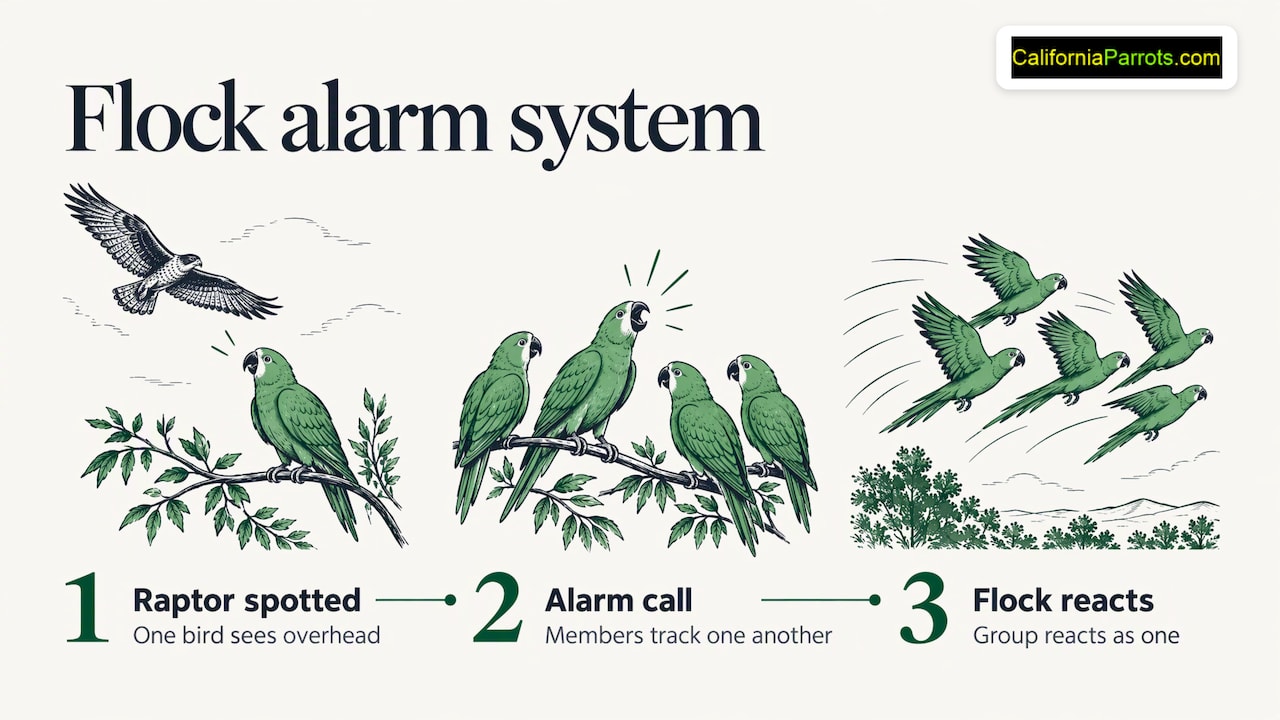
The San Diego Zoo’s parrot profile says parrots are social animals that may gather in flocks of up to 1,000. It adds that flocking helps them watch for predatory birds, and that calls let flock members keep track of one another. For urban Amazons, the flock is a shared alarm system. One bird spots a raptor overhead, calls, and the group reacts as one.
BirdLife links this to intelligence as well: it says that intelligence has helped parrots adapt to their environment and avoid predators, improving their chances of survival.
Flying instead of fighting
Parrots have strong opinions about personal space. The San Diego Audubon Society’s account of naturalized parrots describes how wild parrots use flight to avoid aggressive interactions, with real fighting most likely when defending territory or when another animal comes too close. Backing off costs a bird little, while an injury in a fight could cost a great deal. In a crowded city, where flocks and other wildlife share space, that habit of avoiding conflict is a useful one.
Play as practice
The same Audubon account describes parrot play with objects as a way of learning what those objects are good for, and connects play to survival skills. If you have watched wild Amazons hanging upside down, tugging at twigs or tossing a seed pod, you have seen how a species with a large, curious brain explores. In a city full of unfamiliar objects, an animal that investigates by playing has an advantage over one that avoids anything new.
Voice
Calls do more than raise an alarm. In a flock that spreads over many trees, contact calls keep birds in touch, as the San Diego Zoo describes. At dawn and dusk, when groups move between roosts and daytime areas, that calling is what you hear overhead. Sound is one of the best clues for a birder, because the loud, rolling calls of Amazons often reach you before the birds come into view.
Adapting to a new place: what the evidence shows
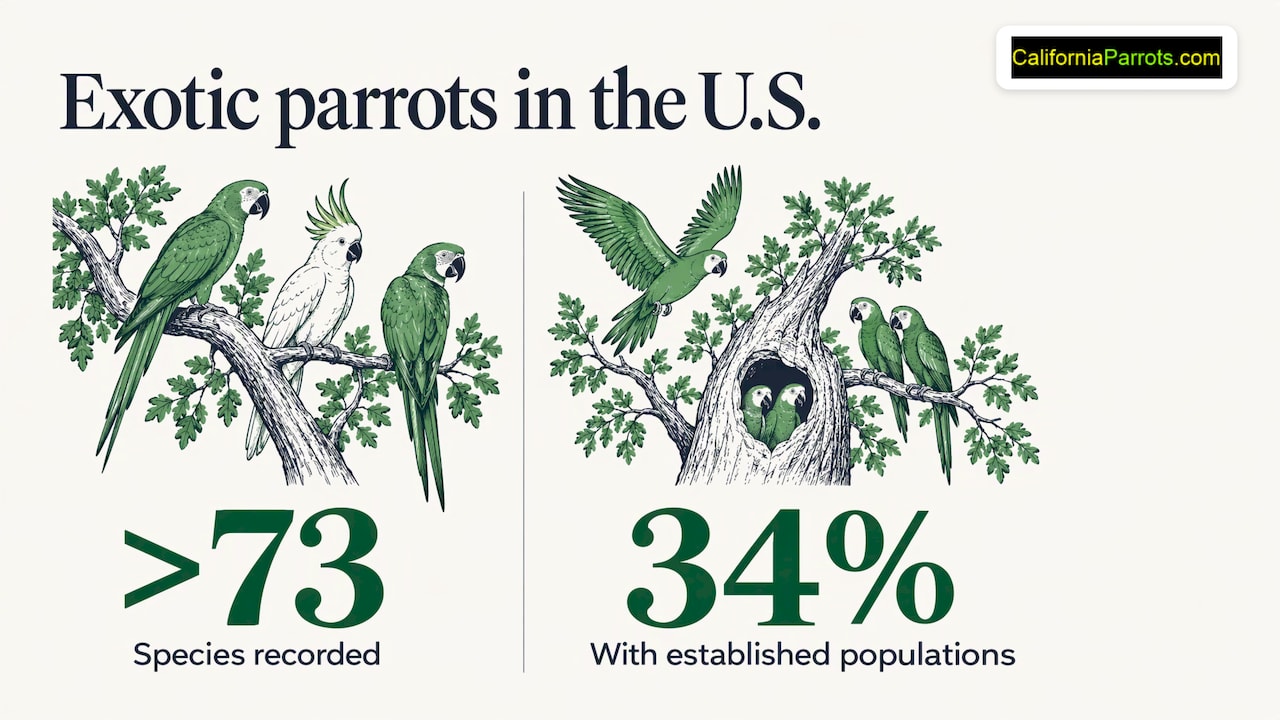
The strongest evidence on flexibility comes from a 2023 peer-reviewed study in the Proceedings of the Royal Society B, Patterns and Factors Influencing Parrot Invasions. It reports that more than 73 exotic parrot species have been recorded in the contiguous United States, and that 34% of them have established populations. In other words, arrival is common, and staying is common enough to be significant.
The same paper recounts a translocation of yellow-naped Amazons. After release, the birds quickly changed how far they ranged, which habitat they used and where they roosted, so that they resembled the resident birds at the release site rather than keeping the patterns they had at the capture site. For an Amazon, then, what looks like a fixed habit can turn out to be quite adjustable. Birds read their new surroundings and follow local cues, including what established residents do.
That finding fits what birders in Southern California report. Our own long-term observers have watched flocks settle into daily routines that follow the city’s rhythms of light, weather and open space. Those routines are learned and passed through the group, not written in the genes. You can read more in the observers’ accounts in our articles.
Why city life works for Amazons
Put the pieces together and the pattern is clear.
| Trait | Type | Why it helps in a city |
|---|---|---|
| Hooked bill and zygodactyl feet | Physical, inherited | Secure grip on trunks, branches and varied surfaces |
| Flocking and contact calls | Behavioral, inherited tendency | Shared vigilance for predators, group cohesion across a spread-out landscape |
| Avoiding fights by flying away | Behavioral | Fewer injuries in crowded, shared space |
| Object play | Behavioral, learned | Quick learning about unfamiliar things |
| Shifting range and roosting | Flexible response | Fit with the local setting after arriving somewhere new |
Each row connects to an idea from the research above. None of it means the city is an ideal home. It means these birds arrived with traits that made the move survivable. For a closer look at the kind of surroundings Amazons use, see our page on Amazon parrot habitat.
One worked example: the red-crowned Amazon
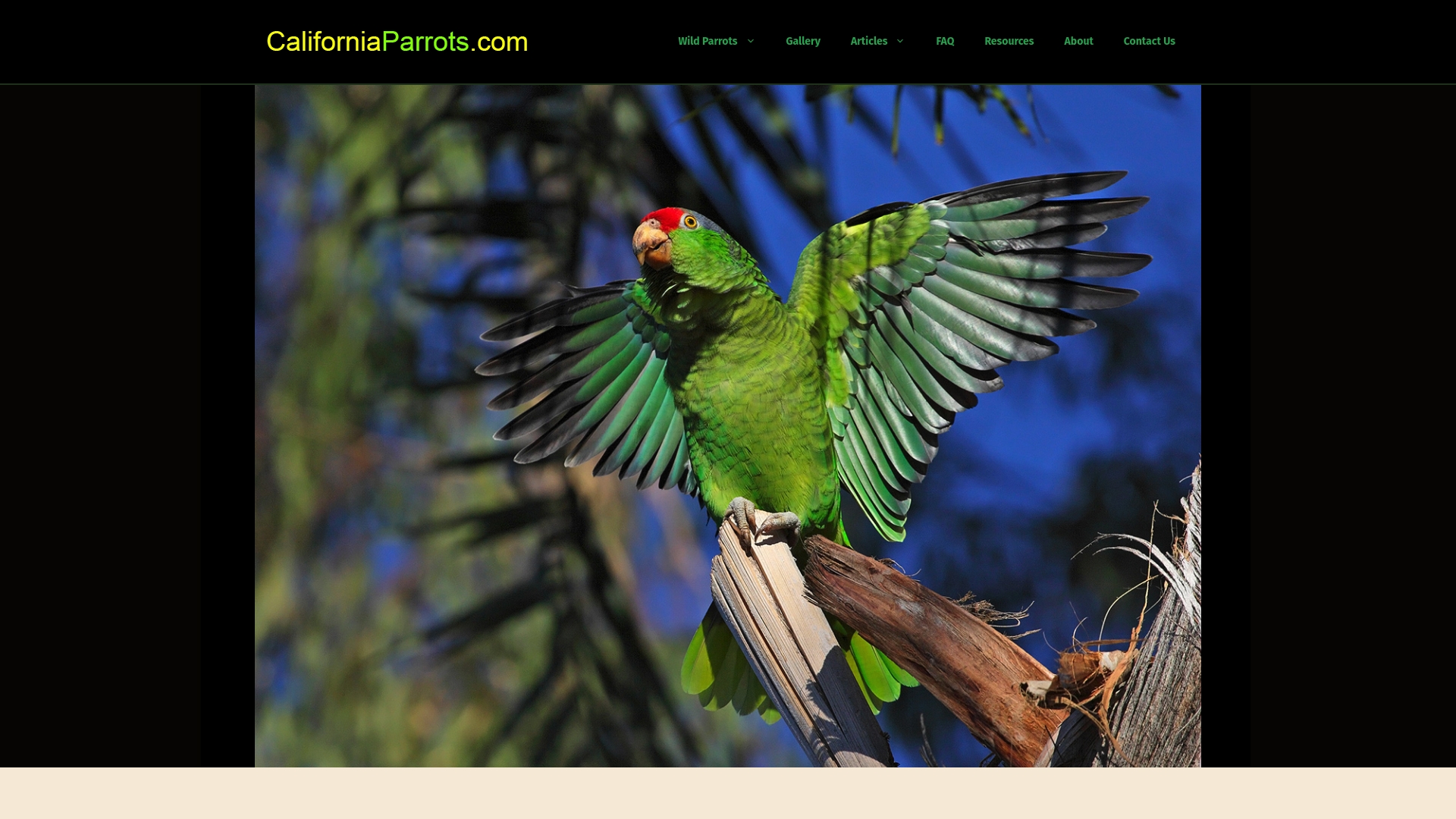
The red-crowned Amazon is the species most closely tied to the story in Southern California, and it shows how adaptations and conservation fit together. The bird has the full Amazon toolkit described above: a strong bill, a grasping foot, a social flock and a loud voice. Its home range in the wild has shrunk, and the species is listed as threatened. Our profile of red-crowned Amazon parrots covers identification, range and conservation, and the page on endangered Amazon parrot species explains the status and the threats in more depth.
This is the paradox that draws many readers to these flocks. A species can be in trouble in its native land and still hold on in a city thousands of miles away, because its adaptations carried it there. The city flocks do not replace the wild populations, but they do show how resilient these birds are.
Adapting to change as a theme
Adjusting to a new environment is stressful for any parrot, wild or kept as a pet. That is why people who relocate a pet bird plan carefully, for example by arranging safe parrot transportation in advance. For wild flocks, the equivalent is simply time and group learning: younger birds follow the habits of older ones, and the flock’s routine becomes the local norm.
How to observe adaptation yourself
You do not need special equipment to see the traits described here. Try these on your next outing, keeping a respectful distance and never approaching or disturbing birds:
- Watch the feet and bill. When a parrot climbs, count how often it uses the bill as an extra limb.
- Listen before you look. Contact calls tell you a flock is near and how spread out it is.
- Notice the flock’s reaction to a raptor. A sudden burst of calling and movement shows the shared lookout at work.
- Note interactions. Look for birds backing away or flying off instead of escalating. That is the avoid-the-fight habit in action.
- Keep a log. Record time of day, weather and what the group did. Repeated notes across weeks reveal routines far better than a single visit.
Photos can help you learn the species first. Our gallery entry page is a good place to practice recognizing each Amazon before you head out.
Keep exploring with California Parrots
Our site is built around daily, firsthand observation of wild Amazon flocks in Southern California, combined with the science behind what the birds do. If this article raised questions, the Wild Parrots pages are the best next step: species guides, conservation status, observers’ stories and detailed galleries, all focused on wild Amazons.
Students will find the FAQ a quick way to check basics, and our home page shows the whole story of the Southern California flocks in one place.
FAQ
What are five adaptations of a parrot?
Five anatomical features commonly cited for parrots are the bill, the jaw, the tongue, the feet and a long neck, according to a 2024 presentation on urban parrots. The hooked bill and the two-forward, two-back toe arrangement are the easiest to spot in the field. Behavioral adaptations such as flocking and calling work alongside them.
Is adaptation the same as learning?
Not exactly. In biology an adaptation is an inherited trait that raises an individual’s fitness, as the Cornell Lab’s Bird Academy explains. Learning is something a bird does within its lifetime. The two connect, because inherited intelligence and sociability make fast learning possible.
Why can wild Amazon parrots live in cities?
They arrive with a strong grip, tight flock behavior and the ability to adjust. A documented translocation of yellow-naped Amazons showed birds quickly changing their ranging, habitat use and roosting to match local residents. Cities offer varied trees and structures, and flocks share what they learn.
Do parrots really live 300 years?
No. That figure is a popular myth, and our site covers wild Amazons rather than lifespan claims. For wild birds, survival depends on predators, weather and habitat, which is why traits such as flocking and alert calling matter so much.
Sources
- Bird Academy’s A-to-Z Glossary of Bird Terms
- Urban Bird Talk: Wild Parrots (WCISA)
- BirdLife International: Everything you need to know about parrots
- PBS Nature: Parrots
- San Diego Zoo Animals & Plants: Parrot
- San Diego Audubon: The Naturalized Parrots
- Patterns and Factors Influencing Parrot Invasions, Proceedings of the Royal Society B (2023)