
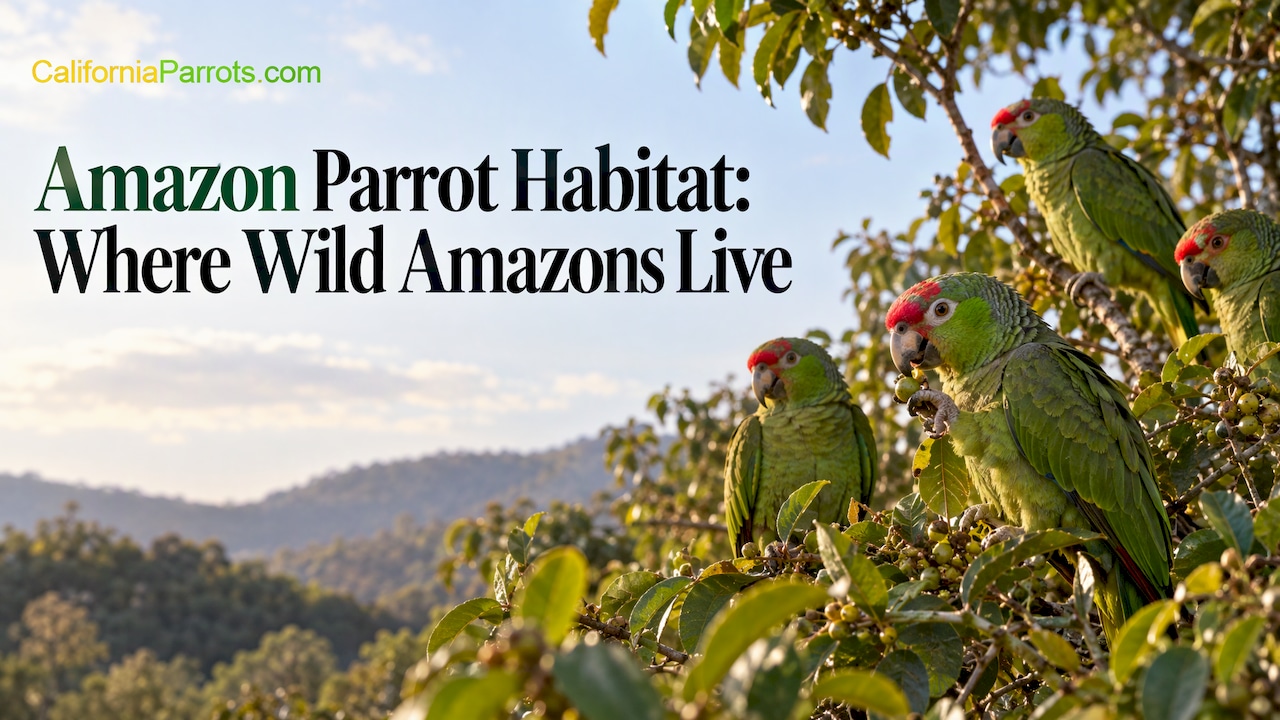
Amazon parrots are birds of the warm Americas. Their native habitat is tropical and subtropical woodland, and in Mexico’s northeast that means dry subdeciduous forest and thornscrub. Habitat loss has pushed several species toward endangered status. Some Amazons have found a second home in the trees of Southern California’s cities and suburbs. This guide explains what a wild Amazon needs from its surroundings, where those surroundings exist, and why a city can stand in for a forest.
Key Takeaways
- Parrots as a family live on every tropical and subtropical continent, with the greatest diversity in South America and Australasia. Amazon parrots belong to the New World branch.
- The red-crowned Amazon’s native habitat is subdeciduous tropical forest and thornscrub in northeastern Mexico. Much of it was cleared in the 1960s and 1970s.
- About 28 percent of parrot species are threatened worldwide, and forest destruction is the leading cause.
- Some displaced Amazons now live in suburban and urban landscapes. The U.S. Fish and Wildlife Service found the red-crowned Amazon does not warrant federal listing because its populations are flourishing in U.S. cities and suburbs.
- A mix of mature trees, open sky and mild weather is what makes a place habitat, whether it is a canyon forest or a tree-lined street.
Table of Contents
- Where Parrots Live Around the World
- What Counts as Habitat for an Amazon Parrot
- The Native Habitat of the Red-crowned Amazon
- Why Amazon Habitat Is Shrinking
- How Some Amazons Found a New Habitat in Cities
- What Makes a City Work Like a Forest
- Native Habitat Versus Adopted Habitat
- Seeing Amazon Habitat for Yourself
- Explore the Wild Amazons Up Close
- Frequently Asked Questions
- Sources
Where Parrots Live Around the World
Parrots have a pantropical distribution, meaning they occur across the tropics and subtropics. BirdLife International describes a range that spans Central America, Mexico, South America, Africa, Asia and Australia. Its description of the habitats runs from South America’s humid rainforests to Australia’s deserts.
The World Parrot Trust counts roughly 330 known species in its Parrot Action Plan. About half occur in the Western Hemisphere and half in the Eastern, and most live in tropical regions. If you came to this page asking “where do parrots live,” the short answer is: warm places with trees, on nearly every continent except Antarctica and Europe.
The Amazon parrots this site follows belong to the Western Hemisphere group. They are native to Latin America, and one of them, the red-crowned Amazon, has a historical range in a small portion of northeastern Mexico. Because everything we document here is an Amazon, the rest of this article stays with them.
What Counts as Habitat for an Amazon Parrot
“Habitat” is the set of surroundings a species needs to survive: climate, shelter, safe roosting places and enough cover to move around. For wild Amazons, a few features matter most.
Trees, and plenty of them. Amazons are woodland birds. They need tall, mature trees for shelter and for sleeping in at night. Where a forest is cut down, the birds lose more than scenery. They lose the structure their whole day is built around. A 2020 study in Global Change Biology by Vergara-Tabares and colleagues found that more than 70 percent of parrot species are forest-dependent, which makes them very sensitive to forest destruction.
A warm, frost-free climate. The neotropics, from Mexico southward, give Amazons mild winters. This is one reason Southern California suits them. Coastal valleys and foothills rarely see a hard freeze.
Room to travel. Amazons are strong fliers and social. A flock moves between roosts and daytime areas, so a habitat is a network of places rather than one spot. Observers in Southern California see this daily: flocks gather in the evening, spread out in the morning and shift their routes through the year. Our page on where the parrots go in spring describes one of those seasonal changes.
The Native Habitat of the Red-crowned Amazon
The red-crowned Amazon is the species most closely tied to Southern California’s wild flocks, and its native range is well documented. According to Birds of the World, its historical range includes a small portion of northeastern Mexico. Its native habitat there was subdeciduous tropical forest and Tamaulipan thornscrub.
Two terms are worth unpacking:
- Subdeciduous forest is tropical woodland where many, but not all, trees drop their leaves in the dry season. It is greener and taller than desert scrub, but it has a distinct dry period.
- Thornscrub is a dense, low woodland of thorny shrubs and small trees, found in the semi-arid lowlands of northeastern Mexico and the nearby borderlands.
The same source reports that populations still occur throughout the historic range but are rarer and more localized in the foothills of the Sierra Madre Oriental and on ranchlands in Tamaulipas. It also notes that much of this native habitat was lost during the 1960s and 1970s. The species is listed as Endangered by both Mexico and the IUCN, the global conservation authority that maintains the Red List of threatened species.
For a full profile of this species, including how to identify it, see our guide to red-crowned Amazon parrots: ID, range and conservation.
Why Amazon Habitat Is Shrinking
Wild Amazons are not alone in facing habitat loss. It is the dominant threat to parrots everywhere. The Vergara-Tabares study reports that 112 of 398 parrot species, almost a third, are threatened with extinction. It also finds that populations of 56 percent of parrot species are decreasing, and that tropical and subtropical forest loss is the main global threat.
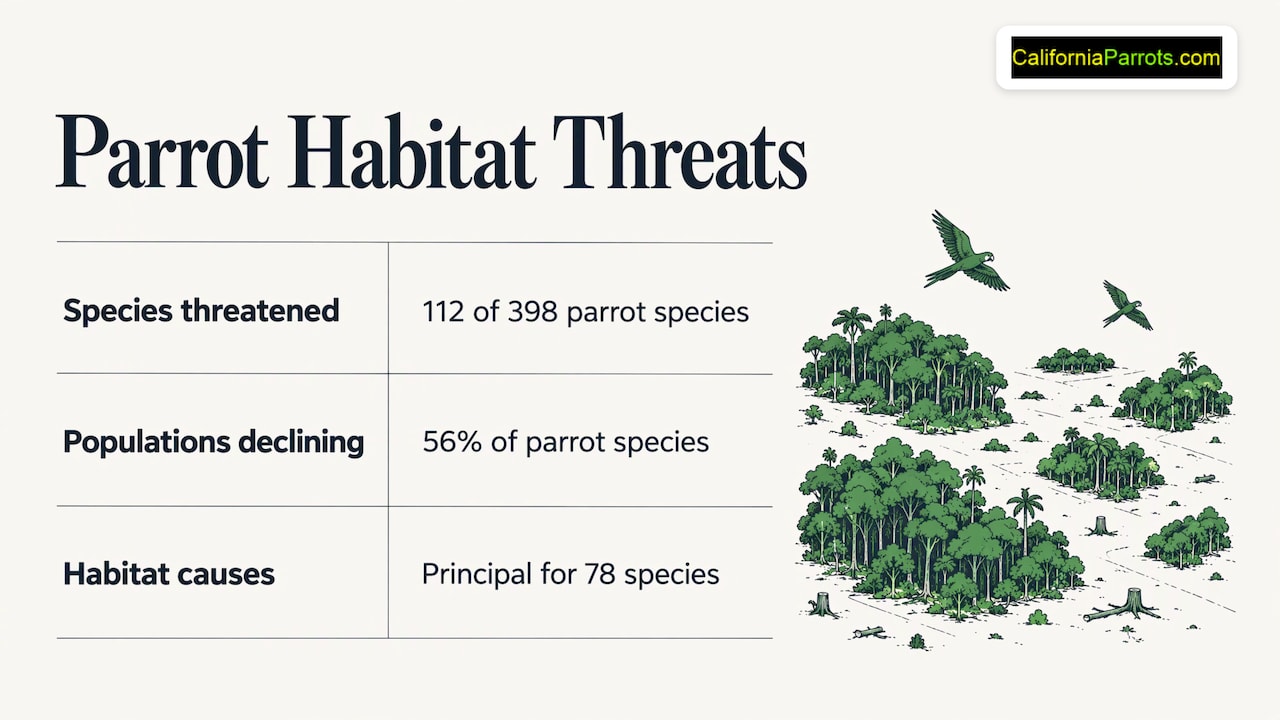
The cause differs by region. The same study identifies agricultural practices as the main threat in the Neotropics, the region where Amazon parrots are native. In plain terms: forest is cleared for farmland and pasture, and the birds that depended on it are left with fragments.
The World Parrot Trust adds a useful figure: 28 percent of extant parrot species are threatened, one of the highest proportions of any major bird family. For 78 species, it names habitat destruction and fragmentation as the principal causes. Fragmentation means a large forest is broken into small, disconnected patches, which makes it hard for a flock to move safely between them.
Poaching adds to the pressure. The Birds of the World account notes that, like most members of the parrot family, the red-crowned Amazon is threatened by habitat loss and poaching for the pet trade.
How Some Amazons Found a New Habitat in Cities
Here is the surprising part of the story. While the native range shrank, red-crowned Amazons began to appear in places they never historically occupied. Birds of the World describes how, over the last four decades, the species has started to occupy a novel niche in suburban and urban landscapes, where a mix of native and nonnative vegetation provides what it needs.
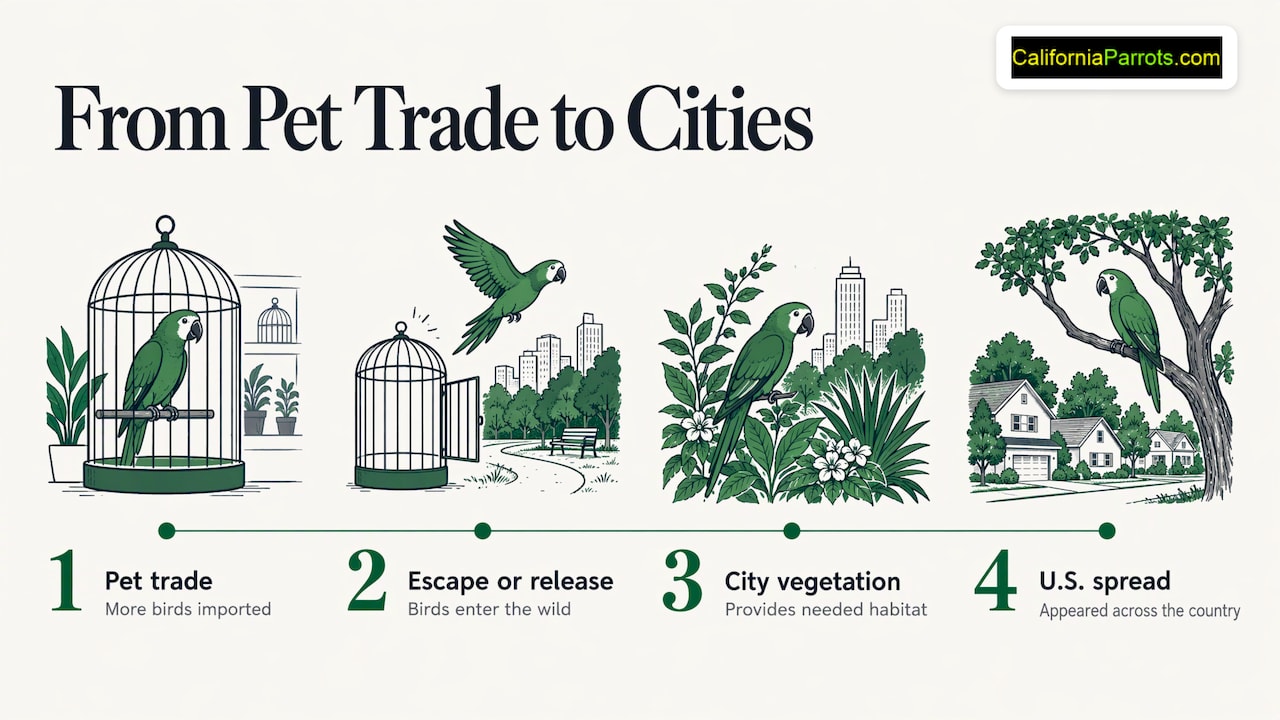
The path to those cities ran through human hands. Audubon quotes ornithologist Stephen Pruett-Jones attributing the spread of introduced parrots across the country to the pet trade: the more birds imported, the more escape or are released, and it took only a few decades for them to show up almost everywhere in the United States. Our page on where the wild parrots came from traces the events behind California’s flocks.
The scale is notable. A study reported by Audubon documented 56 parrot species in 43 U.S. states, and the same coverage says the U.S. Fish and Wildlife Service decided the red-crowned Amazon does not warrant Endangered Species Act listing because its populations are flourishing in U.S. cities and suburbs. The Nature Conservancy’s field guide to feral parrots adds that Florida, Texas and California together support populations of all 25 species of breeding parrots in the country.
What Makes a City Work Like a Forest
It can seem odd that a bird of Mexican thornscrub and tropical woodland would do well beside freeways and shopping centers. The explanation is that a city can reproduce the structure of a forest even though it looks nothing like one.
Mature trees line the streets. Older neighborhoods have tall trees that give shelter and safe places to roost at night, much like the canopy of a native woodland.
Mixed vegetation. Birds of the World points to the combination of native and nonnative plants in suburban areas as the key. Cities hold a planted variety that no single natural woodland offers.
Year-round green. The National Wildlife Federation reports that urban areas support parrots through human-watered exotic plants that produce fruit, seeds and flowers year-round. In a dry climate, irrigation turns neighborhoods into green corridors that stay productive through the dry season.
A mild climate. Southern California’s winters are gentle, close to the frost-free conditions of the birds’ homeland.
Seen this way, the urban flock is not a curiosity out of place. It is a population using the features of its ancestral habitat wherever it finds them. Our overview of wild parrots in Southern California: species, origins and survival goes deeper on how this adaptation plays out over the years.
Native Habitat Versus Adopted Habitat
| Native habitat (northeastern Mexico) | Adopted habitat (Southern California) | |
|---|---|---|
| Landscape | Subdeciduous forest, thornscrub, foothills | Suburban and urban neighborhoods |
| Vegetation | Native forest and scrub | Mix of native and nonnative plants |
| Main pressure | Habitat loss and poaching | Adapting to life near people |
| Conservation status | Endangered in Mexico and on the IUCN list | Federal listing not warranted in the U.S. |
The contrast has a conservation angle. Native habitat remains the foundation of a species’ long-term survival, and protecting it matters. Yet the success of the city flocks shows how resilient these birds are, and it gives researchers and observers a window into their daily lives.
Seeing Amazon Habitat for Yourself
You do not need to travel to Mexico to understand what Amazon habitat looks like. In Southern California, look for the same ingredients described above: tall trees, open sky, mild weather and green neighborhoods. Flocks are most noticeable around dawn and dusk, when they move between roosting spots and daytime areas, and you will usually hear them before you see them: loud, raucous calls overhead.
A few habits make observation rewarding and respectful:
- Watch from a distance and use binoculars rather than approaching a flock.
- Keep a notebook of where the birds fly and at what time. Patterns emerge within a few weeks.
- Note the trees the birds use for perching. Over a season, you will see which ones matter.
- Never chase, feed or capture wild birds. Leaving them undisturbed is part of protecting their habitat.
Explore the Wild Amazons Up Close
Our site is built on years of daily observation of Southern California’s wild Amazon flocks. We combine those personal accounts with species information and photography, so you can see how these birds live rather than just read about it.
Start with the Wild Parrots Gallery for photographs of the flocks, then read our profile of the red-crowned parrot or browse more articles on their conservation story.
Frequently Asked Questions
Where do parrots live in the wild?
Parrots live across the tropics and subtropics, from Central and South America to Africa, Asia and Australia, according to BirdLife International. Most species favor forests and woodlands, though habitats range from humid rainforest to desert. Amazon parrots are native to the Americas.
What is the natural habitat of the red-crowned Amazon?
Its native habitat is subdeciduous tropical forest and thornscrub in northeastern Mexico, as described by Birds of the World. Much of that habitat was lost in the 1960s and 1970s. The species is listed as Endangered in Mexico and by the IUCN.
Why do wild Amazons live in Southern California?
The flocks descend from birds that escaped or were released from captivity. They stayed because suburban and urban landscapes, with their mix of native and nonnative vegetation and a mild climate, meet their needs. Our page on where the wild parrots came from tells the history.
Are wild parrots endangered?
Many are. About 28 percent of parrot species are threatened, according to the World Parrot Trust, and forest loss is the main driver. The red-crowned Amazon is Endangered in its native Mexico, though its U.S. city populations are flourishing.
Sources
- Everything you need to know about parrots, BirdLife International
- Parrot Action Plan, chapter 1, World Parrot Trust
- Global trends of habitat destruction and consequences for parrot conservation, Global Change Biology (2020)
- Red-crowned Amazon, Birds of the World
- Exotic Parrot Colonies Are Flourishing Across the Country, Audubon
- A Guide to The Feral Parrots of the US, The Nature Conservancy
- Parrots Living Wild in American Cities, National Wildlife Federation