
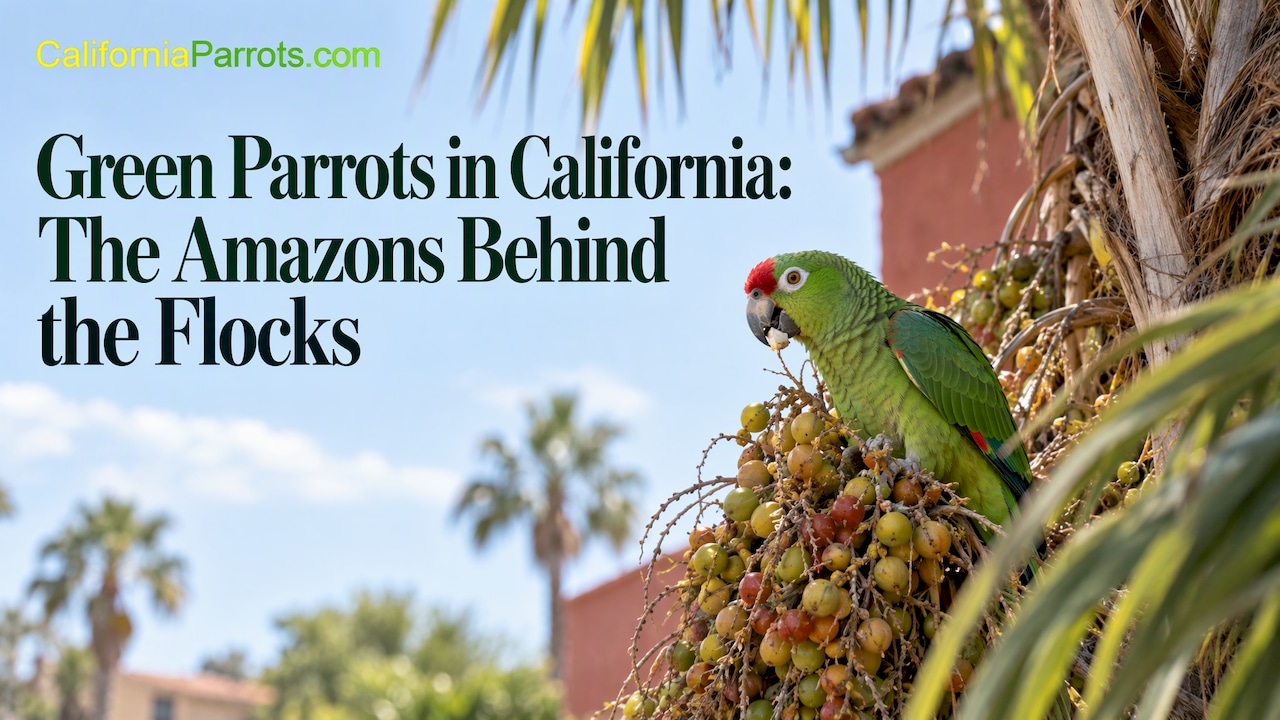
If you have heard a loud, raucous flock pass overhead in a Southern California neighborhood and looked up to see bright green birds, you were most likely watching wild Amazon parrots. None of them are native to California. They descend from escaped or released pets, and several of the species are endangered in the forests of Mexico where their ancestors came from. That is the odd and compelling part of the story: California’s city skies now hold some of the most threatened parrots on the continent.
This guide covers which Amazons make up California’s wild green parrots, how to recognize each one, how they got here, how they live in a city, and what their status means for conservation. It is written for curious readers, birders and students who want the full picture in one place.
Key Takeaways
- The big green parrots flying free in California are Amazons, chiefly the Red-crowned, Lilac-crowned and Yellow-headed Amazon.
- Look for a stocky body, a short squared-off tail, and rapid shallow wingbeats. Head color is the quickest way to separate the species.
- They are descended from pets that escaped or were released. None are native to the state.
- Red-crowned, Lilac-crowned and Yellow-headed Amazons are all listed as endangered in their native ranges, which gives California’s urban flocks real conservation interest.
- Researchers and wildlife agencies have not found these parrots harming native wildlife, so they are not treated as invasive.
Table of Contents
- Which green parrots live wild in California?
- How to tell California’s Amazons apart
- How did green parrots get to California?
- Why Amazons thrive in a California city
- Are California’s wild parrots invasive?
- The conservation paradox
- What the long-term observers see
- Explore the wild Amazons in photos
- Frequently Asked Questions
- Sources
Which green parrots live wild in California?
The parrots most people see are in the genus Amazona, the Amazon parrots. A 1995 identification guide from the Western Tanager describes them as large birds of roughly 33 to 35 cm (13 to 14 inches). They are large-headed and stockily built, with short, squared-off tails. Three Amazons account for most of what you will see:
| Species | Key field marks | Size |
|---|---|---|
| Red-crowned Amazon (Amazona viridigenalis) | Red forehead and crown, bluish nape, ivory-yellow bill | About 33 cm |
| Lilac-crowned Amazon (Amazona finschi) | Green body, pale lilac on the crown and nape, reddish forehead | About 33 cm |
| Yellow-headed Amazon (Amazona oratrix) | Green body with a completely yellow head | About 35 cm |
Sizes come from the Western Tanager guide and the Audubon field guide entry for the Lilac-crowned Amazon. Field marks come from those sources and from a guide to the naturalized parrots of Orange County.
The Red-crowned Amazon is the one you are most likely to meet. A tally of community-submitted observations summarized by the Santa Monica Bay Audubon Society found it the most frequently reported wild parrot in Southern California, with 2,864 observations, well ahead of the Lilac-crowned Amazon at 583. We cover the species in more depth on our Red-crowned Amazon page and our Red-crowned parrot profile.
How to tell California’s Amazons apart
Parrot identification is easier than it looks once you stop chasing every feather. The National Geographic-style field guide to U.S. feral parrots suggests three questions: what color is it, what shape is it, and what does the bill look like. For Amazons, that works as follows.
Start with the shape
An Amazon looks compact and heavy-headed. Its tail is short and squared at the end, not long and tapering. In flight it uses continuous, rapid, shallow wingbeats with the wings bowed slightly downward, according to the Western Tanager guide. If the bird you are watching has a long, trailing tail, it is not one of the big green Amazons.
Then read the head
Head color separates the three common species:
- Red-crowned: a red patch on the forecrown, a bluish nape and a pale ivory-yellow bill. The OC Habitats guide notes that the red extends further back on the head in males.
- Lilac-crowned: a reddish forehead with a pale lilac wash over the crown and nape. Audubon describes it as a large, short-tailed parrot, mostly green.
- Yellow-headed: the easiest of all. A green body topped by an entirely yellow head.
In the field, the two red-and-lilac species can be confusing. Audubon notes that flocks often mix related Amazons, so a single flock can hold more than one species. Look at several birds, not one.
Use your ears
When birds pass high overhead, color disappears and sound is the best clue. The OC Habitats guide describes the Red-crowned Amazon’s flight call as harsh and down-slurred. Learn it once and you will pick out flocks you would otherwise miss.
Why field guides can leave you stuck
If your regional guidebook seems to skip these birds, you are not imagining it. Ornithologist Kimball Garrett’s study in Western Birds points out that standard field guides of the time covered most of Southern California’s free-flying parrots inadequately or not at all. Our species pages and photo gallery are built to fill that gap, with clear images of each Amazon so you can compare marks side by side.
How did green parrots get to California?
The short answer is the pet trade. The Global Birding Initiative explains that most parrots breeding in California are escaped pet-trade birds, while others were probably released on purpose. None are native to the state.
The exact start is debated, and probably involved several events over decades. San Diego Audubon traces the region’s wild parrots back to the 1940s. It also notes that smugglers sometimes released wild-caught parrots at the border to avoid prosecution, adding new birds over time. A 2013 San Diego Reader feature reports that scientific literature documents parrots in Los Angeles County as early as the 1960s, and that a big fire in Pasadena may have freed Yellow-headed Amazons that went on to naturalize.
Whatever the precise trigger, the result is the same. Over several decades, birds that began as pets or contraband formed self-sustaining flocks. A 2019 study, as reported by The Guardian, found that 25 parrot species have formed self-sustaining populations in 23 U.S. states. For more on the sequence of events, read our piece on where California’s wild parrots came from.
Why Amazons thrive in a California city
The Global Birding Initiative credits California’s mild climate and the abundance of exotic vegetation in gardens and parks. A frost-free winter means no hard cold snap to cull the flock, and mature ornamental trees give birds places to perch and shelter.
Their social habits do the rest. Amazons live in large, noisy flocks, and a loud flock is a safer flock. Birds spread out through the morning, then gather again toward evening at communal roosts that can hold hundreds of birds. Flight calls keep the group together and let individuals recognize one another. If you watch a neighborhood at dusk, you may notice the flocks streaming in the same direction as the light fades.
Predators are few. The Guardian reports that outside of a few hawks and other raptors, Los Angeles’s free-flying parrots have almost no natural enemies. Our habitat guide explains more about how Amazons use urban landscapes in general.
Are California’s wild parrots invasive?
This is the question students and conservation-minded readers ask most. According to the Guardian, the parrots are not considered invasive, because they have almost no predators and do not compete with local birds for resources. San Diego Audubon goes further. It reports that the naturalized parrots are not harming native habitat or wildlife, occupy a distinct urban niche and show minimal interaction with other wildlife. It adds that their seed dispersal may even help native plants propagate.
That is a rare outcome for a non-native animal, and it is why researchers treat these flocks with curiosity rather than alarm.
The conservation paradox
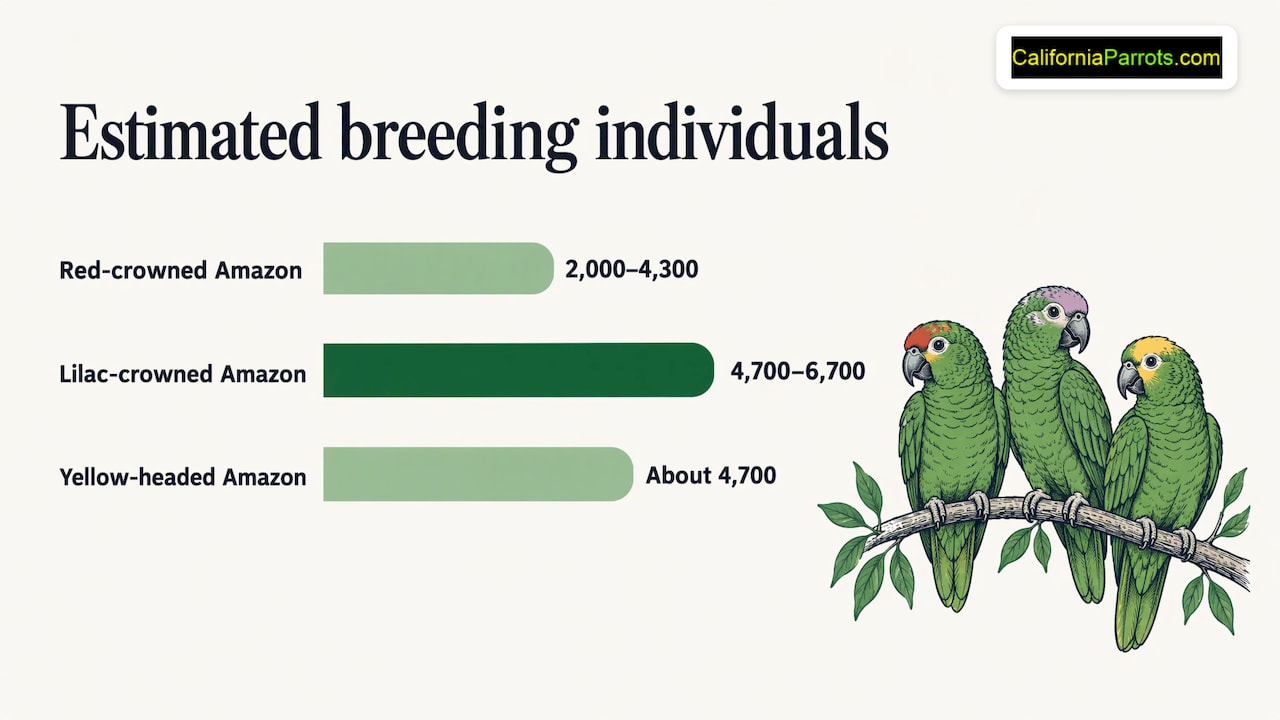
Here is what makes California’s green parrots remarkable. The species flying over freeway interchanges are among the most threatened of their kind at home. San Diego Audubon, citing IUCN and CITES figures, reports the following estimates for the native ranges:
| Species | Estimated native population | Status |
|---|---|---|
| Red-crowned Amazon | 2,000 to 4,300 breeding individuals | Endangered, CITES Appendix I |
| Lilac-crowned Amazon | 4,700 to 6,700 breeding individuals | Endangered, CITES Appendix I |
| Yellow-headed Amazon | About 4,700 breeding individuals | Endangered, CITES Appendix I |
The same document notes that nearly one third of all parrot species are declining. Habitat loss, the pet trade and climate change are the main pressures in native ranges.
CITES Appendix I is the strictest tier of the international wildlife trade treaty, reserved for species threatened with extinction. A listing there means commercial international trade is generally prohibited.
The Guardian describes the resulting situation as a paradox. Descendants of critically endangered Mexican birds are doing well in Los Angeles, and researchers, including laboratory director John McCormack, are studying them for lessons that could matter to conservation. The National Geographic-style guide cited earlier adds that scientists suspect there may now be more feral Red-crowned Amazons in the U.S. than remain in their original Mexican habitat.
San Diego Audubon argues that these urban populations may serve as a unique conservation resource, a living backup population for species under pressure in their home ranges. For a closer look at the status of each species and what recovery would take, see our guide to endangered Amazon parrot species.
What the long-term observers see
Numbers and field marks only go so far. People who have watched the same flocks for years pick up things a quick glance misses: how the flocks move through the day, which calls signal alarm, and how individual birds become familiar over seasons. That is the approach behind our site. We pair years of daily observation with species facts so that you get both the science and the lived detail of what these birds do. Our broader overview of wild parrots in Southern California and our look at feral parrots across the U.S. are good next reads.
Explore the wild Amazons in photos
If you want to practice the field marks above, our galleries are the fastest way. They are focused entirely on wild Amazon parrots, with high-quality photographs that let you compare the red forecrown, the lilac nape and the yellow head at your own pace. Start with the Wild Parrots Gallery, then browse the species pages and more articles when a bird catches your eye.
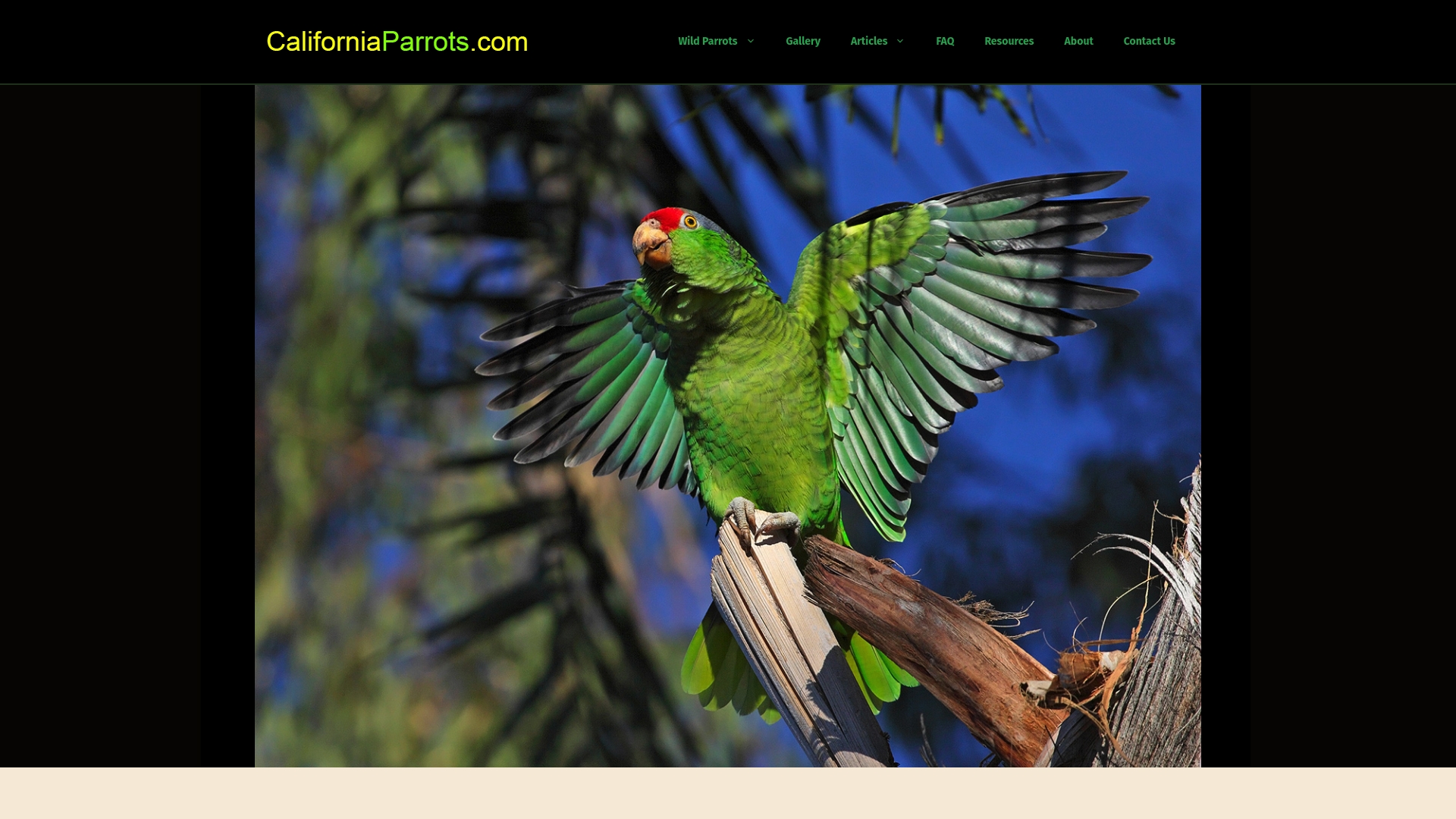
The more you look at these birds, the sooner you will recognize them on your own, and the more their story will mean when you hear that unmistakable call overhead.
Frequently Asked Questions
What are the big green parrots in California?
They are Amazon parrots, large and stocky with short, squared-off tails. The most common are the Red-crowned, Lilac-crowned and Yellow-headed Amazons. Each is identified mainly by its head color.
Are green parrots native to California?
No. According to the Global Birding Initiative, they descend from pet-trade birds that escaped or were released. Over time they formed self-sustaining wild flocks.
Are California’s wild parrots endangered?
In California they are a growing urban presence, but in their native Mexican ranges the Red-crowned, Lilac-crowned and Yellow-headed Amazons are listed as endangered, per San Diego Audubon. That contrast is what makes the California flocks so interesting to conservationists.
Do wild parrots harm native wildlife?
No evidence of harm has been reported. The Guardian and San Diego Audubon both say the parrots are not considered invasive, and Audubon reports minimal interaction with native wildlife.
Sources
- Parrots in California, Global Birding Initiative
- A Guide to the Feral Parrots of the US
- Lilac-crowned Amazon, Audubon Field Guide
- The Naturalized Parrots of Orange County, OC Habitats
- Population Status and Distribution of Naturalized Parrots, Western Birds
- Western Tanager, May 1995
- The Naturalized Parrots, San Diego Audubon
- Did San Diego parrots come from Mexico or Pasadena?, San Diego Reader
- Identifying Red-crowned and Lilac-crowned Parrots in Southern California, Santa Monica Bay Audubon Society
- These parrots came to Los Angeles as pets, then went wild, The Guardian